What's the Difference Between People Who Ask AI and People Who Put Things Out There?
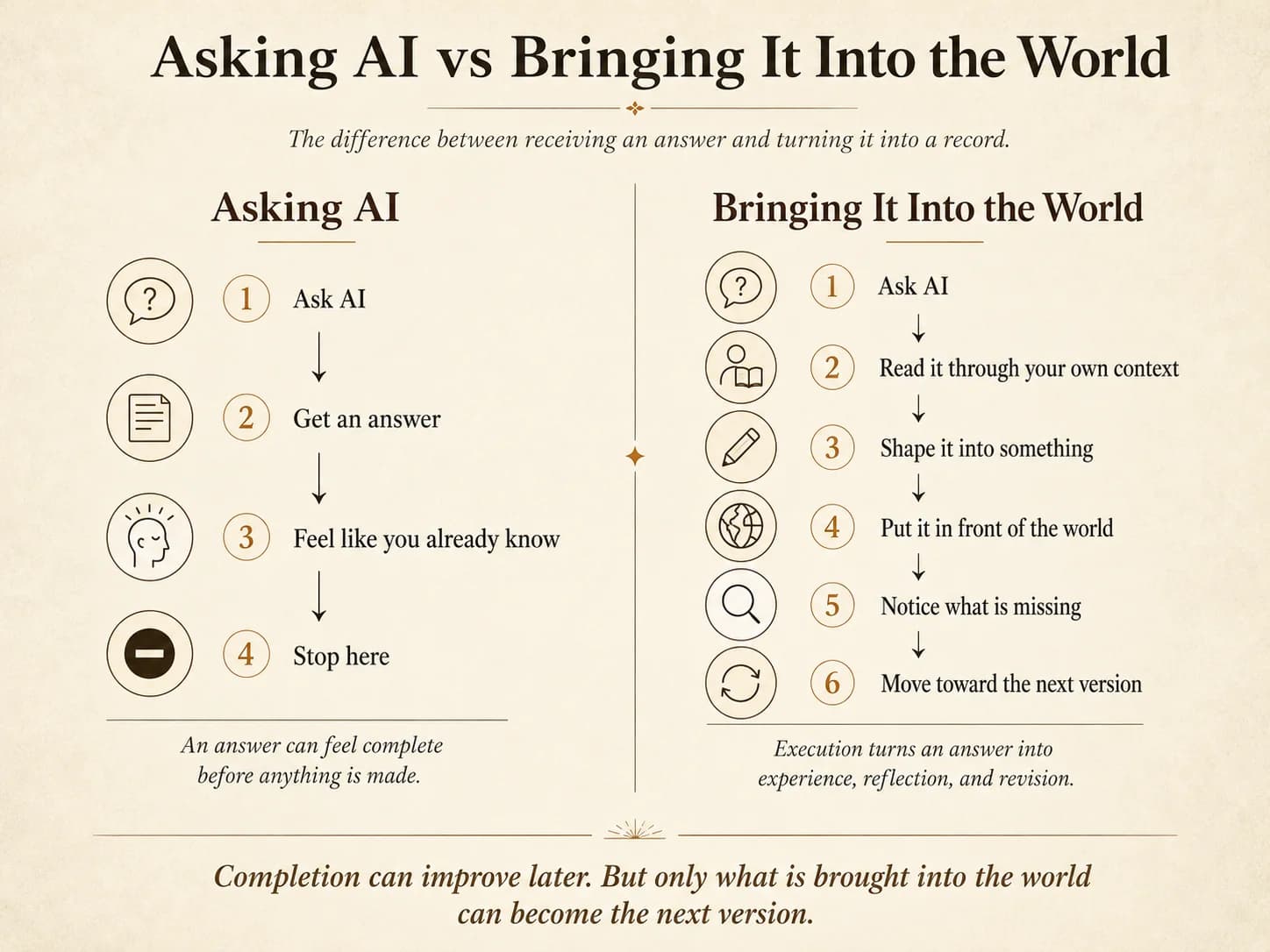
In an age when AI readily provides answers, why is asking different from bringing something out into the world? This asks why the act of creating form—however imperfect—and placing it before the world remains a record of execution.
What's the Difference Between Someone Who Asks AI and Someone Who Actually Ships?
Everyone's Asking AI Now
These days, we can ask AI about almost anything from the start. E-books, YouTube videos, apps, social media posts—one question and you get a plausible sequence. Asking about what you don't know is no longer difficult. It's faster than searching, more contextual than books, and less awkward than asking an expert.
Yet strangely, the person who received the answer and the person who actually shipped something don't stand in the same place.
The difference happens here.
Asking and Making Are Different
There's a clear difference between someone who asked AI how to write an e-book and someone who actually made one. That difference isn't about how much knowledge they have. Knowing the method and actually going through it are different experiences.
In the moment of asking, a person feels like they already have the answer. It feels like the answer belongs to them. But when you actually start, an unexplained gap opens between what AI said and reality. Where to upload the file, how to make the cover, what category to set. These are things you can ask about, but asking alone won't fill the gap.
Some things only happen when you actually go through it.
Rough Work Gets Easily Mocked
The internet is full of ridicule directed at rough work. "You can tell it's made by AI," "Just reorganized content from YouTube," "Just selling a few-page e-book." Sometimes these criticisms are wrong, sometimes they're right.
In the e-book market, there are clearly things copied from somewhere. AI filled in sentences, concepts heard from YouTube were reorganized, and there's no new perspective for readers.
But when this criticism aims at the execution itself rather than the result, the direction becomes wrong. Roughness is an unavoidable condition for someone releasing something for the first time, not a reason not to release it.
The Moment You Ship, You Take Responsibility
Choosing a topic, re-reading your text, making a cover, bundling it as a file, making it public to the world. Throughout this process, a person must continually apply their own judgment. Even if AI helped with sentences, even if you referenced videos, nothing can substitute for these choices.
The moment you ship, you're putting your name on it. Even if no one reacts, that work remains somewhere in the world. Even if you get criticism, that experience becomes yours. Even if no one sees it, the fact that you shaped it and looked at it again remains.
This difference seems small, but it's actually quite deep.
Reconfiguration Isn't Completely New—It's Passing Your Context Through Something
The belief that only something completely new is worth making ultimately prevents anyone from making anything. Completely new things are rare. Writing, video, apps—most reference things that already exist, re-explain concepts that have already emerged, and combine technologies already known.
The issue isn't newness. It's whether you passed your context through it.
Even with the same topic, the grain of the final work differs depending on what question you started from, what readers you had in mind, where you paused and thought again. That grain is different from completeness. Even if it's still rough and lacking, something bearing the trace of your judgment is different from something without it.
People click on content with quick results, but people actually making something pass through slow foundations again.
People Recording Slow Foundations
I remember a developer YouTuber I watch often. Rather than sensational results, he records step by step the foundations you have to pass through to actually make something. It might not be content that goes viral quickly, but for someone just starting, such slow recording lingers longer.
The YouTube algorithm wants fast reactions. Sensational titles, strong first 5 seconds, thumbnails showing results. But the person methodically passing through foundations sits slightly off that path. While it might look like a loss, there are actually moments when someone starting out needs exactly that kind of record.
The act of shipping isn't completed by view counts alone.
Before Completeness, Look for Traces of Execution
Someone who shipped something faces their own shortcomings. Should have written better, should have thought deeper, should have found a better way. This realization doesn't happen when you only think internally. It happens after you ship.
That's why I want to see traces of execution before completeness. Did this person turn their thinking into form? Did they apply their own judgment in that process? And did they place it before the world?
Completeness can increase later. But only people who have shipped can move to the next level of completeness.
That's why some work isn't meaningless because it's lacking—it's meaningful because it created the discovery of what's lacking.