When AI Begins to Act Beyond Answering, What Must We Verify?
As we transition from an era where AI generates answers to an era where AI executes actions, the standard for verification shifts from fact-checking to assessing direction and accountability. Understanding that difference is what we need now.
When AI Starts Acting Beyond Answering, What Do We Need to Verify?
Answers can be read, but actions leave traces
When AI first started writing text for us, creating summaries, and answering questions, we gradually developed a sense of how to handle those results. We read them, look for odd bits, and fix them. If the facts don't check out, we verify them. If there are no sources, we find them ourselves. A way of reviewing what AI produces, like an editor would, naturally took root.
At that stage, verification was essentially about working with text. The output could be read, and wrong parts could be corrected. Even if we mistakenly believed an answer and problems emerged later, mostly we could just rewrite it, edit it, or ignore it.
That's changing now. AI isn't stopping at making answers—it's moving toward executing those answers. This shift doesn't simply mean AI is doing more for us. It means the object of verification itself is transforming.
Answers can be read. Actions leave traces.
What does it mean for AI to act?
When people first hear that AI acts, they might picture physical robots or autonomous vehicles. But the AI actions we encounter in daily life now begin much more quietly.
It's email apps moving beyond drafting replies to sending them. It's calendars going beyond finding free time to actually booking meetings. It's search moving beyond showing results to finding the information you want, comparing it, summarizing it, and moving through the next steps. It's code being written and then executed and deployed.
This is called an AI agent. It takes a single instruction and chains multiple steps together on its own, choosing and using necessary tools, and deciding its next action based on intermediate results.
One important thing: this agent function doesn't exist only as a separate tool. It's quietly entering email apps, document editors, project management apps, and operating system-level assistant functions that we're already using. It's partly a matter of choice, but at some point it becomes the default.
So "AI acting" isn't something happening separately somewhere. It's becoming an increasingly natural flow within the tools we're already using.
Errors in action create costs
When an answer is wrong versus when an action is wrong, the results differ.
If AI misstates a fact, and the person reading it doesn't believe it, that's where it ends. Even if someone believed it for a while, they can fix it once they learn it was wrong. Text can be changed. Belief can be shifted.
Action is different.
An email already sent remains with its recipient. A scheduled meeting takes a spot in another person's calendar. An executed payment requires a cancellation process. Deployed code runs on servers. A deleted file may be difficult or impossible to recover. Multiple steps taken in the wrong direction need time to be undone one by one.
This is the nature of action errors. They have a cost to reverse. That cost might be time, relationships, data, or money.
A wrong answer gets corrected. A wrong action creates responsibility.
And when an agent executes multiple steps in sequence, an error that occurs early might only be discovered later. An initial instruction was ambiguous, AI misinterpreted the intent, or an unexpected situation arose. Whatever the case, discovering a problem after the action has already moved through several steps makes the path back much longer.
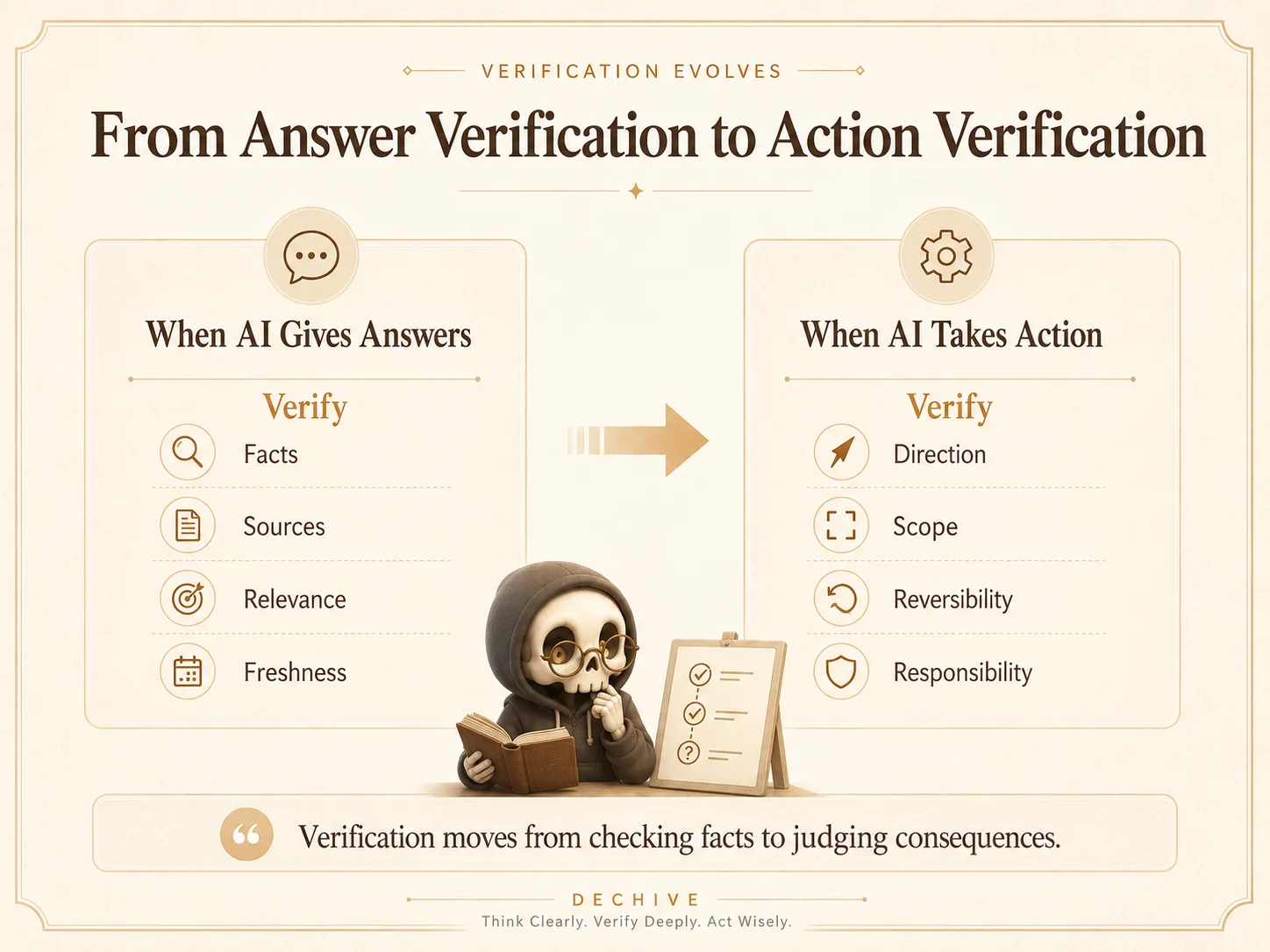
Verification moves from facts to direction
When verifying answers, we mainly asked: Is this statement true? Is this information accurate? Are the sources trustworthy?
Verifying actions requires different questions.
Is this action moving in the direction I want?
When AI drafts an email, grammar and spelling are easy to check. But whether this is the right time to send it, how the recipient will read it, whether this is really what I mean to say—these aren't confirmed by fact-checking. They're matters of context and judgment. AI can refine language, but the reason for using that language is something the person knows.
Is this action within the scope I've allowed?
An agent interprets and executes the intent of instructions. And sometimes that interpretation extends beyond my intended scope. "Organize this document" might reach into related files. "Fix this bug" might expand to revising entire connected code. Verifying the gap between the scope I allowed and the scope AI executed is inseparable from action verification.
Can this action be reversed if it's wrong?
Not all actions carry the same weight. Saving a draft and sending it are different. Running something locally and deploying it to a server are different. Deleting something in a test environment and erasing real data are different. The more irreversible an action, the heavier the weight of confirmation before execution.
Who is responsible for the results of this action?
The results of any action always belong somewhere. Even if AI sent an email, there's someone who allowed it to be sent. Even if AI deployed code, there's someone who approved the deployment. Responsibility doesn't disappear—it becomes clearer who bears it.
These four questions aren't a checklist. They're sensibilities that should operate naturally each moment an action happens. Before approving an action AI proposes, pause, verify direction and scope, consider whether it can be reversed, and recognize that responsibility rests with you.
Convenience shifts the position of judgment
It's easy to think that as tools become more convenient, judgment disappears. But what convenience actually does is shift where judgment happens.
More automation means that routine and manageable decisions move inside AI. As a result, the judgments left for people become weightier. What goal to set, how much to delegate, how to recognize signals to stop midway. These don't become easier even with automation.
The reason convenience feels like it eliminates judgment is something else. As more things are processed automatically, human attention scatters. Rather than thoroughly checking each result, we follow the flow. As trust builds, checking frequency naturally drops. But there's a moment when we forget that trust is only valid in familiar situations.
Agent mistakes happen more in new situations than in routine work. Unfamiliar context, unexpected variables, ambiguous instructions. In any of these cases, AI interprets toward the pattern closest to its training. That interpretation might differ from what I want.
So as tools become more convenient, something grows more important: the ability to recognize moments when judgment is needed. A sense for distinguishing situations AI handles well from situations requiring human involvement. That sense must persist even as automation becomes comfortable.
You need criteria for delegation
This isn't saying we should use AI agents less. Routine procedures, work flowing within established systems, many tasks that are inefficient for humans to do directly—it's natural for these to move into AI. And it's useful.
The problem is when that distinction isn't clear.
What can you delegate to AI, and what must a person keep hold of entirely? This distinction must exist so that delegation leads to convenience, and without it delegation leads to mistakes.
Things worth delegating tend to have these qualities: results are easy to verify, scope is clear, mistakes are not hard to undo, your personal context doesn't need major involvement.
Things people must keep are the opposite: they require context and judgment, results affect other people or external systems, mistakes are hard to reverse, you know the meaning of the choice best.
You can hand work to AI, but you cannot hand off judgment.
This doesn't mean distrust AI. It means your way of trusting AI must change. Trust in answers builds through fact-checking. Trust in actions builds while confirming scope, direction, and reversibility. Having those criteria lets you use AI more comfortably. Without criteria, convenience amplifies uncertainty.
People remain after answers
Dechive has held this question from the beginning. AI produces answers. Dechive verifies those answers.
That question now expands one step further. When AI doesn't stop at producing answers but continues into action, what requires verification changes too. Checking facts alone is no longer enough. We must verify direction is right, scope is appropriate, things can be reversed, and where responsibility lies.
This feels hard because fact-checking is relatively clear. Right or wrong—it divides neatly. Direction, scope, and responsibility demand judgment within context. That context includes parts AI cannot know. Your goals, your relationships, what you can and cannot handle.
So the more AI automates, the higher the position humans occupy: seeing direction, setting boundaries, judging where to stop. As simple execution moves into AI, judgment and responsibility become more clearly a human domain.
People remain after answers. What remains isn't one click, but the responsibility to judge whether that click should happen.
When AI makes answers, we must verify facts. When AI proposes actions, we must verify direction and scope, reversibility and responsibility. The age of verification isn't an age of suspecting AI—it's an age of learning what to delegate and what to hold.