Agile is a method for verifying direction, not speed.
Why Agile remains necessary even as AI accelerates implementation speed—examined through the perspectives of solo developers and SaaS, focusing on how direction validation works in practice.
As AI makes code faster to produce, speed is becoming an increasingly common resource in development.
Now a single person can build screens, integrate APIs, and deploy all by themselves. Work that once required a team can become an afternoon's work for one person.
The question is whether we can now build the right product faster.
Speed does not replace direction. When direction is wrong, fast speed only amplifies waste faster.
Agile is not a name for fast development. It is closer to a verification method to avoid holding onto the wrong direction for too long.
This document summarizes the history of Agile, its core concepts, misconceptions, limits, and why this way of thinking remains valid in the AI era. It is not an introduction to Agile. It covers Agile for those who already know it but want to understand why it works, why it fails, and how to reconsider it now that AI has arrived.
How to Read This Document
This document does not introduce Agile as a fast development methodology.
First, we examine why Agile emerged and what problem it was meant to solve. Then we clarify what tools like Scrum, Kanban, and XP are designed to verify. After that, we discuss what Agile means again for enterprises, founders, and solo developers in the AI era.
If you already know Agile, you can start from Why We Question Agile Again in 2026 and Criteria for Agile Verification of AI-Generated Results.
If you are new to Agile or want to understand the context, start from Before Agile: Problems Created by Waterfall.
You can tire of reading this document. The purpose is not to understand everything at once, but to return when needed and use it as a verification standard.
Why We Question Agile Again in 2026
When the Agile Manifesto came out in 2001, development speed was made by human hands. In the 1990s when Scrum was first described, and when Kent Beck proposed XP, code was written line by line by people.
The core tension of that era was this: "We know what to build. But it takes too long to build it."
The tension in 2026 is different.
The Development Loop in the Age of Vibe Coding
Claude Code, Cursor, and GitHub Copilot have entered the everyday development loop. Describe a screen layout and code appears. Mention an API structure and endpoints are created. Describe data processing logic and functions are completed.
This flow of iteratively modifying while conveying the feeling of desired results to AI rather than elaborate design is now commonly called "vibe coding."
A solo developer building a working prototype in a few afternoon hours, attaching a landing page the next day, and receiving first users three days later is no longer the exception. What once took a team weeks is now one person's daily work.
Generation speed became the bottleneck, not verification capability
Making things got faster. But that faster speed created a new problem.
Before, there was naturally time to wonder: "Is this right?" You thought while coding. You refined while writing specifications. Slow speed created natural verification time.
When AI makes things fast, you see the next feature before you confirm the current one. You make the next feature, and then you see another. This cycle keeps turning.
Fast completion is not dangerous. Fast certainty is dangerous.
Moving on to the next thing before confirming "this seems right" — that is the new direction-loss pattern in the AI era. Agile existed as a mechanism to avoid holding onto the wrong direction long. But now there is reason for that mechanism to operate even faster.
New tensions in teams where AI agents have arrived
It is not just a problem for solo developers. Similar tensions are emerging in enterprises with teams.
Looking concretely at what is happening in development now:
AI agents processing multiple tasks asynchronously in teams
More PRs being created by AI than by humans
Code writing speed went up, but code comprehension speed stayed the same
A founder built an MVP in a day but couldn't acquire users
Code writing became less of a bottleneck, and requirement verification became one
From this situation, management sees it this way. If we use AI tools, we can make faster. Then we should be able to make more.
"Let's use AI to speed up too." "Isn't it supposed to be faster with AI?"
This pressure is natural. But under this pressure, teams start making things before confirming what they should make. Time to verify direction decreases, time to implement increases.
The result is the same as existing Agile distortion. Running in the wrong direction at faster speed.
So Agile is even more needed in 2026
The core of the Agile Manifesto is "check frequently."
When implementation was slow, checking frequently meant making the implementation cycle shorter. Now that implementation is fast, checking frequently has become more important. Because the speed of running without checking has become faster.
This document covers the method of that checking.
Before Agile: Problems Created by Waterfall
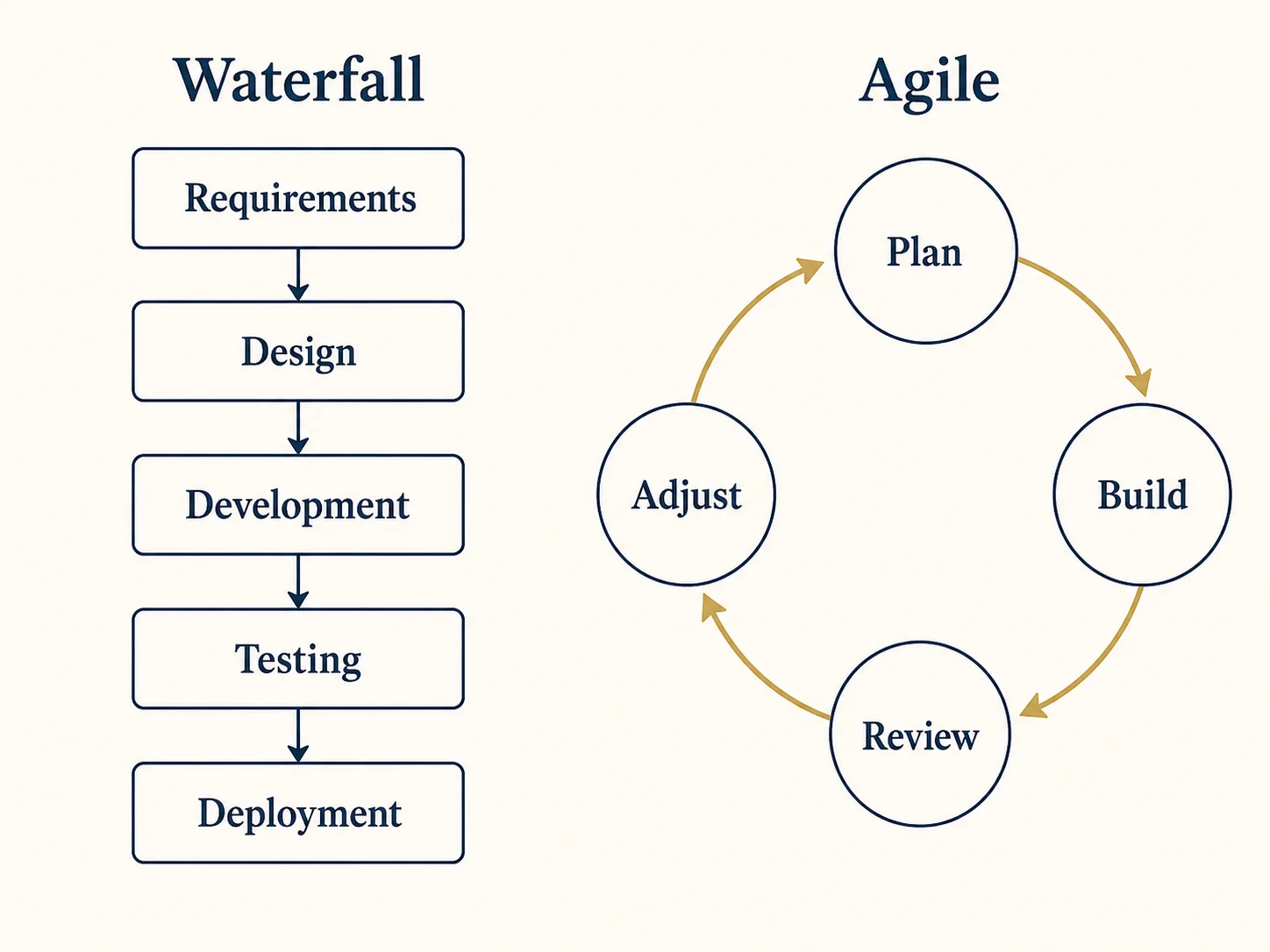
To understand what Agile is, you must first understand what came before it.
When software development began to industrialize in the 1970s, many organizations adopted methods from manufacturing as-is. They thought software could be made in order like building cars in a factory. Once planning is done, design begins. Once design is done, development begins. Once development is done, testing begins. Each stage can only start when the previous stage is completely finished.
This method is called Waterfall. Water flows from top to bottom.
Waterfall looks logical. You cannot develop without design. You cannot design without requirements. That is obvious.
But software has a difference from things made in factories. A car design cannot show a working car before it is complete. Software can show a working version early.
That is where the problem with Waterfall begins.
Late feedback creates costs
In the Waterfall method, you can only see actual working software after all development is complete. If planning took 6 months, design took 3 months, and development took 9 months, you cannot confirm "is this right?" until 18 months have passed.
After 18 months, the market may have changed. The problem you assumed the user had may no longer be their biggest problem. A competitor may have already released something similar.
The more serious problem is the cost of correcting when direction is wrong.
If requirements change just before development starts, you only need to redo design. If direction changes mid-development, you must rewrite code. If you discover direction was wrong after development is complete, you must redo almost everything.
This is called the change cost curve. The later you discover it, the exponentially larger the correction cost.
Waterfall places feedback at the most expensive point on this curve.
Chaos Report and Software Project Failure Rates
Standish Group has tracked software project success rates since 1994. Based on their initial 1994 report, approximately 31% of projects were cancelled, 52% experienced budget overruns or schedule delays, and only 16% were completely successful. While subsequent figures show some improvement trend, the pattern of late feedback in software projects increasing failure costs has been repeatedly observed.
Looking at the causes of these failures, there is a common pattern: requirements were unclear, user participation was lacking, and the gap between expectations and reality was too large.
In Waterfall, users are typically involved at the initial planning stage and the final review stage. During the 18 months in between, the development team works based on the requirements they understood initially. If users' thinking changes during that time, there is no way to reflect it.
The problem of documents replacing reality
In Waterfall, each stage is connected by documents. The requirements document creates the design document, and the design document creates the development specification.
These documents model reality. The problem is that reality changes while documents lag behind.
Developers build based on documents. If documents do not accurately reflect real requirements, developers make something wrong no matter how well they build it.
Agile was a response to this problem. Instead of documents, frequently show actual working software. Then you can discover early if direction is wrong.
Agile Manifesto: What the Original Text Actually Says
In February 2001, seventeen software developers gathered at a ski resort in Snowbird, Utah. They were already experimenting with better development methods in their own ways. XP (Extreme Programming), Scrum, DSDM, Adaptive Software Development, Crystal, Feature-Driven Development — different methods but with shared thinking.
Existing methods are too heavy. They need to be lighter and more responsive to change.
What came from this meeting was the Agile Manifesto. A short declaration consisting of four values and twelve principles.
Four Values
The original text reads:
We are uncovering better ways of developing software by doing it and helping others do it. Through this work we have come to value:
Individuals and interactions over processes and tools
Working software over comprehensive documentation
Customer collaboration over contract negotiation
Responding to change over following a planThat is, while we value the items on the right, we value the items on the left more.
The important part is the last sentence. The Agile Manifesto does not say that documentation, contracts, and plans are unnecessary. It says it values interaction, working software, collaboration, and responding to change more highly than them.
Losing this nuance leads to misunderstanding Agile as "coding without documentation."
Twelve Principles
The Manifesto supports the four values with twelve principles. Summarized, they are:
Customer satisfaction comes first. The highest priority is satisfying customers by continuously delivering valuable software early.
Welcome change. Welcome requirement changes even late in development. Agile processes harness change for competitive advantage.
Deploy frequently. Deliver working software in cycles of weeks to months, with shorter cycles being better.
Business and developers work together. Customers and developers must work together throughout the project.
Center on motivated individuals. Projects should be built around motivated people. Give them the environment and support they need and trust them.
Face-to-face conversation. Face-to-face conversation is the most effective way of conveying information within and to development teams.
Working software is the measure of progress. Measure progress by actual working software, not completed documents or plans.
Sustainable development. Developers, users, and sponsors must be able to maintain a constant pace indefinitely.
Technical excellence and good design. Continuous attention to technical excellence and good design enhances Agility.
Simplicity. The art of maximizing the amount of work not done is essential.
Self-organizing teams. The best architectures, requirements, and designs emerge from self-organizing teams.
Regular retrospection. At regular intervals, the team reflects on how to become more effective and adjusts accordingly.
Looking at these twelve, there is no principle saying "make faster." What is there is "check frequently," "respond to change," "go sustainably."
Context of the Manifesto
Most of the people who wrote this declaration were already experimenting with alternative methods in actual practice. Kent Beck's XP came out in 1999, and Scrum had been developed since the mid-1990s by Ken Schwaber and Jeff Sutherland.
The shared problem consciousness among them was the same. Too many software projects are failing. The reason is mostly process and communication problems, not technical problems.
The Manifesto put a name to this shared consciousness.
Major Agile Methodologies
Agile is not a single concrete methodology. There are multiple methodologies that implement the values and principles of the Agile Manifesto. We examine the most commonly used ones.
Scrum
Scrum is currently the most widely used Agile framework. It is used not only in software development but in many other fields.
The core of Scrum is Sprint, a fixed time period. Usually 1-4 weeks, most commonly 2 weeks. Within a Sprint, the team sets a goal, does work to achieve that goal, and reviews the results at the end of the Sprint.
Scrum Roles
Product Owner determines what should be built. Manages business value and priority and maintains the Product Backlog. Product Owner handles "why" and "what."
Scrum Master supports the process. Helps the team understand and execute Scrum properly, removes obstacles, and creates an environment where the team can work without disturbance. Scrum Master does not handle "how." The team decides "how."
Development Team are the people who actually make things. They consist of people with necessary roles like developers, designers, QA. In Scrum, the team is self-organizing. The team decides who does what.
Scrum Events
Sprint Planning is the meeting at the start of a Sprint. Decide what to do this Sprint. Bring items from Product Backlog to Sprint Backlog.
Daily Scrum (or Daily Standup) is a short synchronization meeting held daily. What did you do yesterday, what will you do today, is there anything blocking progress — the team recognizes obstacles and cooperates around these three questions. It is a direction check, not a progress report.
Sprint Review is the review session at the end of a Sprint. Show what was completed and receive feedback. The important thing is that this should be a place to get real feedback, not just a demo.
Sprint Retrospective is a session where the team reflects on how it worked. What went well. What did not go well. What will we do differently next time. Many teams skip this or conduct it formally, but then Scrum loses its core learning loop.
Each Scrum Event is a Mechanism for Verifying Direction
If you view Scrum events simply as a schedule, they become a formality. You must understand what each event is for in terms of direction verification for it to work meaningfully.
Sprint Planning is where you decide "what hypothesis will we verify this time." It is not about bringing in a to-do list, but about deciding what you will learn this cycle.
Daily Scrum is a short loop where the team verifies direction is correct every day. It asks "does what was blocked yesterday affect direction," not report progress.
Sprint Review is a place for direction verification, not a demo. The purpose is for actual users or customers to try what was made and verify "does this solve my problem." If it becomes an internal team applauding itself, direction verification is missing.
Sprint Retrospective is a mechanism for changing the next loop, not a reflection session. The core is "what was different between last time and this time, what will we change in the next loop." Without Action Items, the loop does not improve.
Product Owner is not the person deciding what to do, but the person responsible for hypothesis priority. "This feature will solve this problem for this user" — managing the priority and verification criteria of that hypothesis is the Product Owner's actual role.
Product Backlog and Sprint Backlog
Product Backlog is a list of everything the product needs, ordered by priority. Most important and well-defined at the top, less important and more vague toward the bottom. A living document that constantly changes.
Sprint Backlog is items brought from Product Backlog that the team will do this Sprint. The team manages it directly once the Sprint starts.
User Story
Backlog items are usually written as User Stories. "[Role], I want [feature]. So I can achieve [reason]." The purpose is to remember who needs what and why, not write a function specification.
User Story has Acceptance Criteria attached. If you do not specify the condition for completion, "completion" differs between people.
Definition of Done
Definition of Done (DoD) is the team's agreed-upon definition of "complete." Is "code writing complete" completion? Is it complete through test writing? Through code review? Through QA? Through staging deployment? Through production deployment?
This definition differs between teams and organizations. The important thing is that the team must agree explicitly. Implicit "completion" creates problems later.
Velocity
Velocity is the amount of Story Points the team completes per Sprint. Story Point is a unit measuring the size and complexity of work relatively.
Velocity is a tool for prediction. If a team completes an average of 40 Story Points per Sprint, a 120 Story Point project will take roughly 3 Sprints.
The problem with Velocity is when it becomes a target. If "we must achieve 50 Story Points this Sprint" becomes a target, the team starts manipulating Story Point estimates. Goodhart's Law. When measurement becomes the target, it is no longer a good measurement.
Kanban
Kanban came from Toyota's production system. It is the software development application of the card system Toyota created in the 1940s to manage inventory.
If Scrum is centered on time periods (Sprint), Kanban is centered on flow.
Kanban Board
Kanban board visualizes work status. The most basic form has three columns. To Do, In Progress, Done.
Teams organize columns differently. For example: Backlog → Analysis → Development → Review → Testing → Deployment → Complete.
The purpose of this board is to see where work gets stuck. When cards start piling up in a particular column, that is a signal of bottleneck there.
WIP Limit
The core concept of Kanban is WIP (Work In Progress) Limit. It limits the number of tasks you can work on simultaneously.
For example, if the Development column's WIP Limit is 3, at most 3 tasks are in progress. If 3 are already in progress, you do not start a new task.
This may feel counterintuitive. Do not you need multiple things in progress to look busy?
But when you do many things simultaneously, each gets slower. Context switching costs occur. Completion time for each gets delayed. WIP Limit restricts what you do at once to speed up flow.
Scrum vs Kanban
Scrum has fixed time periods. At the end of a Sprint, you review and make plans. Kanban has no time period. When work completes, you pull the next task.
Scrum has the whole team working toward the Sprint goal together. Kanban has individuals managing their work flow.
Scrum has defined roles. Product Owner, Scrum Master, Development Team. Kanban maintains existing roles.
Which is better depends on context. Scrum might fit if there is much plannable work and the team needs to align on direction together. Kanban might fit if you process unpredictable support work or continuous incoming requests.
Many teams mix the two. Sometimes called Scrumban.
Dechive Note
Kanban is not a board for doing more work. It is a verification mechanism for seeing where flow gets stuck. WIP Limit does not restrict speed, but reveals bottlenecks so the team solves them. The column where cards pile up knows the answer.
XP (Extreme Programming)
XP is a methodology Kent Beck created in the late 1990s. It is centered on technical practices. The idea is to push good things to extremes.
If testing is good, always write tests first (TDD). If code review is good, always code in pairs (Pair Programming). If integration should happen often, integrate multiple times a day (Continuous Integration).
Test-Driven Development (TDD)
TDD is writing tests first, then writing code that passes the tests.
You repeat Red → Green → Refactor cycles. Write a failing test (Red), write the minimum code passing it (Green), improve code (Refactor).
The advantage of TDD is that it improves design. Code hard to test is usually poorly designed. Thinking about testing first naturally produces more modular design.
The disadvantage is it takes time to get used to and feels slower at first. Especially with UI-heavy development, applying TDD is difficult.
Pair Programming
Two people code together at one computer. One writes code (Driver), the other thinks about strategy and reviews (Navigator). You swap roles frequently.
Intuitively it seems inefficient. Two people on one task. But research shows code quality improves, bugs decrease, and knowledge shares better across the team. However, it depends on context. Effect is not large for simple repetitive work.
Continuous Integration (CI)
Code is integrated often. Code merges to main branch multiple times a day.
The purpose of CI is to reduce pain of integration. Branching long then merging creates large conflicts hard to resolve. Merging often creates small conflicts easy to resolve.
Most software teams now use CI. CI tools (GitHub Actions, Jenkins, CircleCI, etc.) automatically run tests and check if builds pass.
Dechive Note
XP is not a way for developers to code harder. It is a technical verification mechanism so code does not crumble amid rapid change. TDD makes you design code first, Pair Programming reveals what one person cannot see alone, CI confirms each change does not break everything.
Now that AI creates code, XP's technical practices matter more. AI can make code that works without tests. But code without tests is code you cannot change direction with.
SAFe and the Problem of Large-Scale Agile
Scrum, Kanban, XP are methodologies for small teams. For large organizations where dozens or hundreds work, a different approach is needed.
Created for this are SAFe (Scaled Agile Framework), LeSS (Large-Scale Scrum), Nexus, and others.
SAFe is the most complex form. It has complex structures like PI Planning (Program Increment Planning), Agile Release Train, Solution Train. Many enterprises have adopted SAFe but there is much debate about its effectiveness.
There is criticism within the Agile community too. Some of the Manifesto's authors say SAFe lost Agile's core values. Too many rules and processes eliminate adaptability rather than enable it.
Implementing true Agile in large organizations is still a difficult problem. Rather than covering this in depth, recognizing this is still an experimental domain is more honest.
Why Agile Was Misunderstood as "Fast Development Methodology"
As Agile became widely known, it drifted from its original meaning. Understanding this is important for using Agile properly.
The problem of tools replacing purpose
As Scrum spread, Scrum's form came to the forefront. Do Daily Standup. Run Sprint. Do Retrospective. These came to be viewed as Agile practices.
But following form does not make you Agile.
Answering three questions in Daily Standup but the team not actually helping each other is merely a daily progress report.
Running Sprint every 2 weeks but getting no feedback in Sprint Review is Waterfall with short cycles.
Having Retrospective where you repeat the same things and nothing changes is merely a formal procedure.
Spread of Certified Scrum Master
Scrum Alliance and Scrum.org began issuing Scrum Master certifications. You can become a "Certified Scrum Master" after a few days of training.
The certification itself is not bad. But when organizations view certification as evidence of Agile capability, problems emerge. A certified Scrum Master enters a team and enforces process, but often distances from actually solving the team's problems.
Rebranding Disguised as "Agile Transformation"
Many enterprises declared "Agile Transformation." But often what actually changed was only surface.
Team names changed. Meeting names changed. Sticky note boards appeared. But decision structures remain hierarchical, requirements still come from above, and feedback loops still do not exist.
"Agile" became a name but substance was missing.
Speed pressure and Agile distortion
As Agile was understood as "a way to deploy fast," enterprises began adopting Agile to increase speed.
"If we do Agile too, we can make faster."
Under this expectation, teams feel pressure to speed up. Sprint speed must increase. Must complete more Story Points.
This is opposite to Agile's purpose. Agile is not for making faster but for making things right.
Under speed pressure, teams often compromise quality. They reduce testing, accumulate technical debt, hurry reviews. Short-term looks fast but long-term becomes slow.
What Matters Is Feedback Loop, Not Sprint Cycle
The core of Agile, said in one sentence, is the feedback loop.
Check frequently if direction is right. If wrong, fix it. Build again and check again.
Three things are needed for this loop to work.
First, there must be something to check. Working software. Something that actually works and users can try. Not design mockups or documents.
Second, someone must check. Real users or customers. Just looking within the development team does not verify direction. People who make something see it from a different angle.
Third, what was checked must be reflected in the next direction. If you get feedback but nothing changes, the loop is not complete.
Many teams miss one or more of these three.
They demo but only to internal stakeholders, not real users. They get feedback but put it in the Backlog to see someday. They do Sprint Review but nothing changes.
Sprint without feedback is Waterfall with short cycles.
Running Sprint every 2 weeks is not Agile. Checking every 2 weeks if direction is right and adjusting is Agile.
Types of feedback
Feedback comes in several kinds.
User feedback. Reactions of people actually using the product. The most valuable feedback but hardest to get. Obtained through user interviews, user testing, surveys, actual usage data, etc.
Data feedback. Quantitative information from analysis tools. Which features people use, where they drop off, how often they return. Advantage is quantitative but does not explain "why."
Team feedback. Code review, design review, QA. Feedback on technical quality. Feedback on execution quality more than direction.
Market feedback. Changes in competing products, market trends, industry movements. Slower and indirect but impacts strategic direction.
Most direct is user feedback. That is why Agile values "collaboration with the customer."
Speed of feedback loop
Feedback loops are better when faster. But realistic constraints exist.
Ideally you get feedback daily, but having user interviews daily is hard. Even as daily data accumulates, meaningful patterns need time to show.
Sprint's meaning is creating the minimum cycle for receiving feedback. If you get real feedback even once every 2 weeks, you can correct direction much faster than monthly or half-yearly.
Agile and the AI Era: What Changed
As AI enters development, Agile's context is changing.
Before AI: Implementation was the bottleneck
Before AI, the slowest part of software development was implementation. Even if you knew what to build, actually building took time.
In this context, Agile's "build fast and deploy often" seemed like raising implementation speed.
After AI: Direction became the bottleneck
AI has made implementation speed faster. Tools like Claude Code, GitHub Copilot, and Cursor greatly raised code generation speed.
Now a person who knows "what to build" can build it much faster.
The problem is: AI does not help figure out "what to build."
If you tell AI "make a feature users will like," AI cannot make that judgment. AI can implement explicit requests. But whether that request solves the user's actual problem, AI cannot know.
Implementation got faster means direction judgment importance grew.
In the same time, you can make more. But if direction is wrong, in the same time you make more wrong things.
Implementation speed is fast. But unverified direction is dangerous.
The direction verification risk in working with AI
AI develops fast to requests. Ask it to make the next feature, it makes it. Deploy it and you see another feature. Then another. This cycle turns very fast.
In this speed, "wait, is this the right direction?" becomes hard to ask. It is hard to stop while running fast.
But without stopping, there is no direction checking. Fast running without direction means running fast to the wrong place.
Agile was a mechanism to not hold onto the wrong direction long. Now that mechanism needs to operate even faster.
AI agents in teams with new tensions
Not just a solo developer problem. Similar tensions are emerging in enterprises with teams.
Looking concretely at what happens on development now:
AI agents simultaneously processing multiple tasks asynchronously in teams
PR made more by AI than by humans
Code writing speed rose, code comprehension speed stayed the same
Founder built MVP in a day but could not acquire users
Code writing became less the bottleneck, requirement verification became one
Management sees it this way. We can make faster with AI tools. Then we should make more.
"Let us also use AI to speed up." "Is not it supposed to be faster with AI?"
This pressure is natural. But under this pressure, teams start making before confirming what to make. Time to verify direction shrinks, time to implement grows.
The result is the same as existing Agile distortion. Running in the wrong direction faster.
So Agile is even more needed in 2026
The core of Agile Manifesto is "check frequently."
When implementation was slow, checking frequently meant shorter implementation cycles. Now that implementation is fast, checking frequently became more important. Because speed of running without checking became faster.
This document covers the method of that checking.
What Must Agile Verify Again in Enterprises
AI tools entered the team. Developers use Copilot, planners make documents with AI, team leads ask AI for reports.
Has the team become more Agile.
In most cases, no.
Take an example of what happened in one team. After adopting AI, during 2 week Sprint they built 8 features. Nearly double the earlier speed. Management was satisfied. But 30 days later looking at retention metrics, nothing changed. Of 8 features, only one was repeatedly used by users, the rest users could not find. Speed rose but direction was not verified.
AI adoption does not make teams Agile
AI raises individual productivity. You make code faster, documents faster.
But Agile's core is the team verifying direction in a loop. This loop is a different problem from individual productivity.
Does the team get real user feedback at Sprint Review. Does something actually change at Retrospective. Does Product Owner write the hypothesis clearly. Does the team frequently ask if direction is right.
These AI does not speed up. Rather, raising implementation speed means you can continue running without direction check faster too.
More features completed does not mean better product
Jira tickets close fast. Velocity goes up. More Story Points complete each Sprint.
So is the product improving.
No guarantee these two connect. Must verify separately whether fast-completed work is work of value to users.
Some teams with AI raising ticket processing speed have seen retention stay the same or drop. They are making more but not making better.
"The number of completed tickets" is not the team's real progress metric. "The number of features solving problems users really want" is.
Product Owner's role becomes more important
AI raising implementation speed means Product Owner's questions matter more.
"Is this really needed?" "Whose what problem does this feature solve?" "Could we use the time for something better?"
If Product Owner does not make these questions clear, the development team with AI can very quickly make much. Which of it is actually needed is not verified.
AI-era Product Owner is not someone managing feature lists. They are someone responsible for hypotheses the team must build. Without clear hypothesis, what AI quickly makes is just fast waste.
Must rewrite Definition of Done for AI-created outputs
AI made code. What is the criterion for that code to be "complete."
Existing Definition of Done included criteria like:
Code review passed
Test writing complete
QA passed
Deployment-ready state
AI era requires new items in this criterion:
Can the team explain this code
Can you write in one sentence what user problem this feature solves
Does AI have overbuilt parts (unnecessary complexity, features not used)
Are there event logs or metrics to observe this feature
AI makes what you request. The team must verify whether that request is actually needed, whether what was made works as intended.
Sprint Review must be direction verification, not demo
Sprint Review in teams using AI to raise implementation speed shows more things.
But showing more does not make Sprint Review more valid.
Sprint Review's purpose is verifying what was made fits direction. Ideally real users or customers participate and give feedback.
If what you make faster with AI does not get real user validation at Sprint Review and only gets internal applause, it becomes losing direction faster.
Real bottleneck in enterprise Agile is decision speed
When AI raises implementation speed, the team's next bottleneck appears. For most enterprises, that bottleneck is decision-making.
How long does it take to decide "can we make this feature." How long until Product Owner decides to change direction. How long until feedback from Sprint Review gets reflected in the next Sprint.
If implementation is fast but decision is same as before, the team wastes more time waiting for decisions.
Agile's "responding to change" only works when decisions are fast. AI raising implementation speed makes clear that decision speed must rise too.
Agile for 1-Person Developers and Solo SaaS
Agile was mostly designed assuming a team. Product Owner, Scrum Master, Development Team must all be different people. Daily Standup is for team synchronization. Sprint Review is to show customers.
So what does Agile mean for a solo developer building alone.
Getting direction wrong is easier when alone
When you work in a team, naturally other perspectives enter. Planner asks "do users want this." Designer asks "is this hard to use." Another developer asks "is this approach right" in code review.
Working alone, this intersection is missing. Only my thinking, only my judgment executes immediately. No friction confirming direction.
This is a double-edged sword. You can decide and execute fast. But when direction is wrong, discovering it is hard.
The problem of becoming attached to what you make
Makers become attached to what they make. Hard to objectively see if this feature is really needed.
This is sometimes called the IKEA effect. Tendency to value what you made yourself more.
Working alone, this tendency is stronger. No outside perspective balances it.
When working with AI, this tendency can get worse. If AI quickly implements what you want, what you want becomes reality faster. But whether what you want is what users need is not verified.
How solo developers verify direction
A few methods solo developers can use to verify direction.
Early sharing and beta users. Show some users before completion. Can feel uncomfortable showing unpolished work, but early feedback is cheaper to fix. Share on Product Hunt, Reddit, relevant communities, Twitter, etc.
Individual user interviews. Talk to people who might use it. Do not describe features, first listen to what problems they have. "What do you think of this feature?" is less useful than "how are you handling this situation now."
Logs and analytics. See what features actually get used, where people drop off. Posthog, Mixpanel, or even simple server logs let you get behavior data.
Regular self-review. Weekly or biweekly, ask yourself "is what I am making the right direction." Without this time, easy to keep running and lose direction.
Public build logs. Share what you are making on Twitter or blog. Called "Build in Public." Sharing gets feedback, and getting feedback makes you think more clearly.
Conversation with imaginary customer. Make your target user concrete as a person. "30