Can AI Replace Learning?
AI explains, answers, and organizes information. But learning is not about receiving answers—it's about building structures that allow you to continue asking questions, verify claims, and think critically.
Ask AI a question, and you get an answer. Ask it to explain a concept, and it explains. Give it a difficult document, and it organizes it. Send it code you're stuck on, and it solves it. What took days before now comes back in seconds. There is no doubt that the time and effort required to obtain necessary information has decreased.
On the surface, learning seems to have become much easier. When you don't know something, you just ask AI. If you don't understand, you ask again. There is less need to flip through thick books, combine search terms, or tentatively ask someone else like before.
But that is where the question begins.
In an era where we can receive answers more easily, are we truly learning better?
Yet learning might not simply be the act of receiving an answer. Learning might be the entire process of receiving an answer, doubting that answer, narrowing down the question, verifying the evidence, restating it in your own words, leaving it in a structure you can retrieve later, and ultimately transforming it through your own judgment. If that is the case, then while AI providing answers quickly can be the beginning of learning, it cannot be learning itself.
AI has lowered the barriers to learning. That is a clear and tangible change. But lowering the barrier is not the same as completing the learning.
This article is not an argument to avoid AI. Rather, it examines what role AI can play in learning and what parts still remain with people. The work of transforming answers created by AI into a structure where people can think again—that is closer to the direction learning should take in the AI era. Understanding that direction is also how to use AI better.
Part 1. What AI Has Changed About Learning
The Cost of Asking Questions Has Decreased
Before AI, asking questions in learning came at a high cost.
You had to ask a teacher or colleague, and for that to happen, the timing had to be right. You had to worry about being judged for not knowing something. To search for answers, you first had to know the right search terms; if you didn't know the terms, searching itself became impossible. To look something up in a book, you had to at least guess which chapter it might be in. Multiple conditions had to align just to ask a single question.
AI has lowered all these costs.
Now, whenever a new concept appears that you don't understand, you can ask about it immediately. If you still don't understand, you can ask again. You can request different analogies to explain it. You can ask for easier examples, more complex examples, code examples from a specific domain, step-by-step explanations—all of it is available on demand. Even if you ask a question based on a misconception, AI can grasp the context and correct you.
The psychological cost of asking has also decreased. AI does not judge. There are no embarrassing questions. Whether you ask at two in the morning, an answer comes right away. This has real significance in lowering the barrier to entry for learning. Previously, there was a minimum threshold: "I need to know at least this much before I can ask a question." AI has eliminated that threshold.
However, lowering the cost of asking is not the same as raising the quality of questions.
Being able to ask many questions is different from asking accurate questions. Being able to ask easily is not the same as understanding exactly what you don't know before asking. When the barrier is lowered, more comes in, but the quality of what comes in does not necessarily rise together.
Previously, to ask a question, you had to know at least something about it. The process of formulating a question itself already presupposed some level of understanding. But in the AI era, you can ask questions from a state of complete ignorance. That in itself is not bad. However, asking questions when you don't even know what you don't know can become directionless exploration. Accumulated directionless exploration does not deepen understanding. To make use of the lowered cost of asking, there needs to be awareness of how to refine the questions themselves.
The Accessibility of Explanations Has Increased
AI explains things well.
It gently untangles difficult concepts. It makes abstract content concrete through analogies. It converts sentences filled with jargon into simple language and breaks complex processes into step-by-step stages. It consistently structures good explanations regardless of field.
Thanks to this ability, content that was previously difficult to access can now be quickly grasped in outline. When reading an abstract in a paper and getting stuck at a certain point, asking AI to "explain this paragraph simply" returns it in a readable form. When learning a programming language for the first time and encountering unfamiliar concepts, AI explains them by connecting them to familiar concepts. Previously, this quality of explanation could only be obtained by meeting an expert directly or finding a well-written book. Now it comes with a single question.
The increase in accessibility is positive.
But as easier explanations become more available, something new needs to be guarded against. The easier an explanation, the faster the sense of "I understand" emerges.
When reading a difficult book, misunderstanding becomes obvious. You know that you read something but don't grasp it. But when listening to AI's fluent explanation, nodding along happens all too naturally. Because the explanation is well-structured, the sensation of "following along" quickly transforms into the sensation of "understanding." Following the flow of an explanation and internalizing a concept are different things, but the difference becomes invisible before AI's fluent explanations.
If you don't verify whether that sensation is genuine understanding, easy explanations can actually accelerate the speed of misconception.
The more easily AI explains, the weaker the signal that "I haven't understood this." When reading difficult texts, not knowing made itself obvious, and that became motivation to look further. Before AI's fluent explanations, that signal doesn't appear at all. This is why, as learning's accessibility increases, intentional effort to verify understanding must increase equally.
The Threshold for Repetitive Learning Has Lowered
AI does not tire.
It answers the same question ten times over. If you ask it to explain with a different analogy this time, a different analogy appears. You thought you understood yesterday but feel confused again today—you can ask again. It shows no annoyance. There is no sign of boredom. No matter how much time passes, it responds with the same attitude.
This provides practical help for repetitive learning.
Previously, there was a burden in asking: "Do I really need to ask this again?" Continuing not to understand the same concept was uncomfortable for yourself and felt like imposing on others around you. AI removed that discomfort. You can ask the same question again without shame. You can receive explanations in multiple different ways.
Repetition is fundamental to learning. Few things are completely understood after hearing them once. Learning requires encountering the same concept in different contexts again, confirming it in different ways, and practicing with it directly until it becomes second nature. AI reduced the friction in that repetition.
However, there is a point to be cautious about in repetition as well.
Repeating the same question does not always mean deepening learning. If you ask "What is overriding?" every day for a week and receive similar answers each time, that is not deepening understanding—it is looking at the same entrance repeatedly. Repetition has meaning when it has direction. Repetition that returns to the same place each time may create a sense of familiarity, but it does not deepen understanding.
More questions are not the same as deeper understanding. The lowered threshold for repetitive learning is an opportunity, but how to use that opportunity remains a human responsibility.
For repetition to be meaningful, it must have direction. "Asking about the same concept again" and "asking about a part I previously failed to understand from a more specific angle" have similar forms but different directions. The former is receiving an answer again; the latter is filling in gaps in previous understanding. AI has certainly lowered the threshold for repetition, but it does not determine the direction that repetition should take. Determining that direction is the role of the learner.
The Speed of Learning and the Speed of Misconception Have Accelerated Together
AI increases the speed of learning.
When an unfamiliar concept emerges, you can grasp its outline in seconds. When a related concept comes to mind, you can ask about it immediately. You can draw the outline of content that would take days to learn from a book or lecture in a single conversation. This speed is something previous generations of learners did not have.
However, when the speed of learning increases, something else accelerates alongside it: the speed of misconception.
When listening to AI's fluent explanations, the sensation of "now I understand" arrives quickly. When unclear concepts return as neatly organized sentences, there is a feeling of having gained something. When long, complex content is summarized briefly, it appears that you have grasped the essence. All these sensations feel similar to actual learning.
But whether that sentence is accurate, whether I truly understand it, and whether I can actually apply it are separate issues.
More precisely, in the AI era, the speed at which misconceptions form—the illusion that learning is complete—has also accelerated. Previously, when you didn't understand something, the signal "I don't know" eventually came, even if it took time. Now, a signal that you understand appears far too quickly, even when you actually don't.
This is why the AI era requires both the speed of learning and the speed of verification. You must be able to doubt quickly enough to match the speed at which you receive answers. You must be able to quickly locate missing context to match the speed at which you receive summaries. Speed has value when direction is correct. When direction is wrong, the faster you go, the further you stray.
This is the core tension in AI-era learning. AI provides answers faster, and that speed makes learning appear to accelerate. However, the essential work of learning—doubting, verifying, restating things in your own words, forming judgments—cannot be resolved by speed. These tasks take time, and sometimes slowness is necessary. As AI increases the external speed of learning, the need to deliberately manage internal processing speed—the speed at which understanding is formed—has also grown.
Part 2. Why Receiving an Answer Is Not the Same as Learning
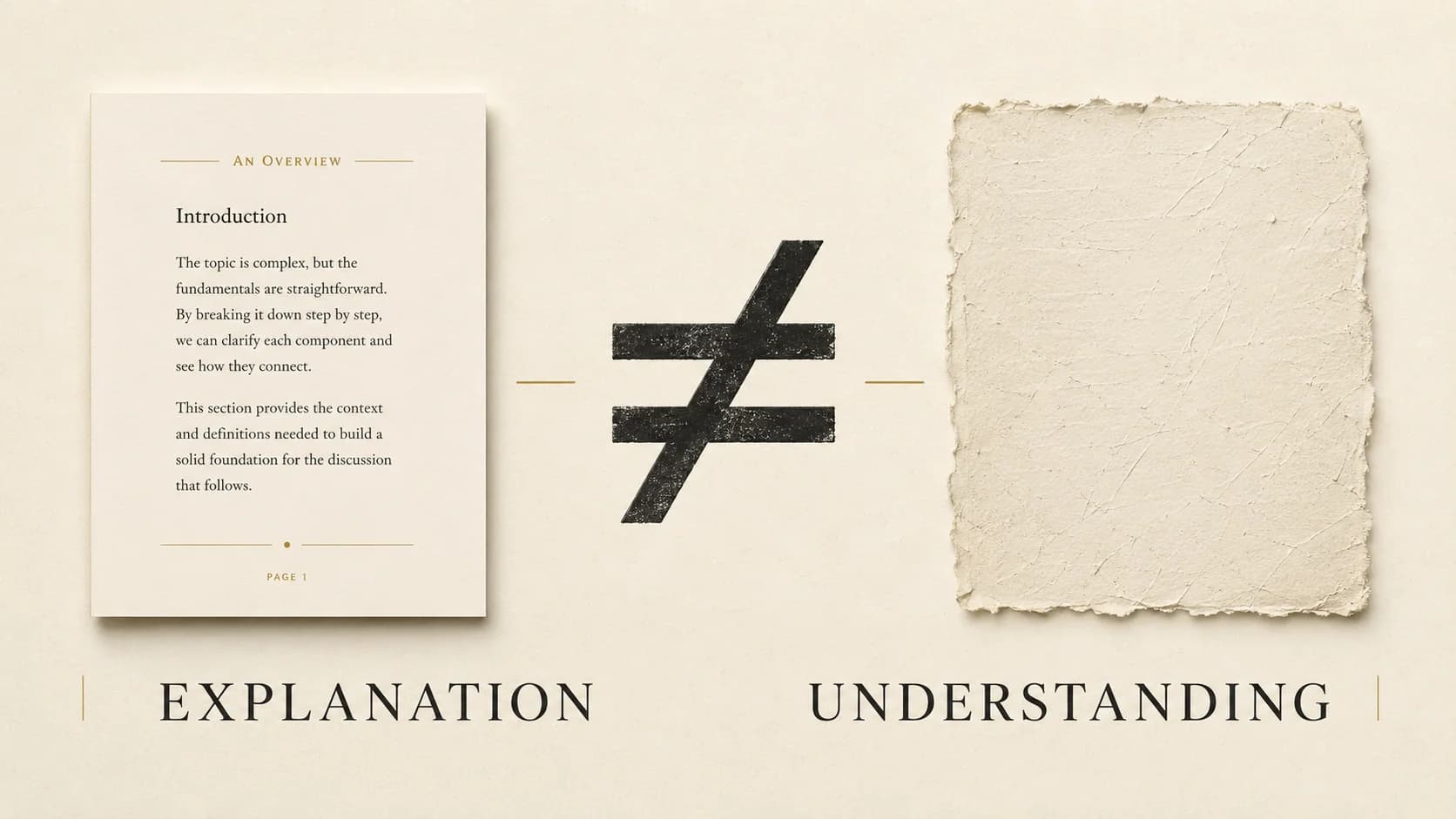
The more fluent an AI's explanation, the less visible the gap between following the explanation and actually understanding it. Part 2 examines what forms this gap takes.
Following an explanation is not understanding
AI explanations are fluent.
They are logical, consistent, and flow smoothly. The analogies are apt, the examples are plausible, and they are well-organized step by step. After hearing an explanation, it feels natural to nod in agreement.
But that nodding does not prove understanding.
Understanding has several verification criteria. Can you explain it in your own words? Can you apply the same concept even when the examples change? Can you sense something wrong when incorrect explanations are mixed in? Can you discover where you get stuck when you actually try to use it? If these four things don't happen, it's closer to following the explanation.
For example, suppose you had AI explain Java's overloading and overriding to you. "Overloading is distinguishing methods with the same name by differences in parameters, while overriding is redefining an inherited method in a child class." You can nod in agreement when you hear the explanation.
But if you see Parent p = new Child(); p.method(); in actual code and cannot immediately judge which method will be executed, then that explanation is not yet yours. You heard the outline of the concept but did not understand how it works. If you cannot explain in your own words the difference between compile-time binding and runtime binding, and how the results differ, then hearing the explanation and understanding it are different things.
This is not a problem unique to AI. The same gap exists between listening to lectures, reading books, and hearing explanations versus understanding. AI can narrow that gap more quickly, but it cannot eliminate the gap itself. The more fluent the explanation, the less visible that gap becomes—this is a characteristic of the AI era.
Understanding is formed through the process of directly applying what you learned after receiving an explanation, encountering exceptions, making mistakes, and correcting them.
You can verify this in another way. After feeling like you "understood" what AI explained to you, when you encounter a different situation related to that content, can you apply it immediately? In many cases, you cannot. For example, even if you hear the explanation "a closure is a function remembering the scope in which it was declared" and feel like you understand it, when you first see a pattern that uses closures in actual code, you often cannot immediately recognize that it is a closure. Hearing an explanation and recognizing a pattern are different levels of understanding. AI explaining well means it helps you quickly pass through the first level of understanding, not that it automatically creates deeper levels of understanding.
Summaries reduce memory burden but do not replace judgment
AI is good at summarizing.
It extracts the essence from long documents and presents complex content in structured form. It condenses a several-thousand-word paper into "three key arguments." This provides practical help in processing information. When you cannot read everything, it is useful for quickly getting your bearings.
But summarization is not judgment.
A well-organized sentence has the power to make you feel like you understand. When you see a cleanly summarized three-point summary, you get a sense of "now I know." But whether those three points are the most important ones from the original text, whether any context is missing, and whether you can actually use this summary remain unconfirmed—only a sense of relief comes.
The cleaner the summary, the more you should be careful about missing context.
When a long paper is summarized into five lines, everything outside those five lines disappears. Limitations, conditions, premises, counterexamples—these are often just as important as the paper's main arguments. You need to directly verify what AI judged as less important when summarizing and whether that judgment fits your purpose.
It is particularly important when facing an important decision, when learning content you will later be responsible for, not to look only at the summary and check the original text. A summary can be a starting point but should not become a conclusion. Before trusting a summary, you should ask what is missing and how far the content can be trusted.
AI summaries have another characteristic. AI does not extract "what is important when viewed as a whole" but rather "what appears most relevant to this question." Depending on what context you are learning this content in and which parts are important to your purpose, AI's summary results can differ. And if you don't make this explicit, AI chooses what appears most important in a general context. There is no guarantee this matches your purpose. When using summaries, you should also check "is there nothing important to my purpose missing?"
Examples aid understanding but do not complete verification
AI creates good examples.
It presents abstract concepts through concrete scenes. When you request examples because something is unclear, it creates multiple ones. If you want examples tailored to a specific domain, it structures them accordingly. The richness of examples is a clear strength of AI.
But examples are scenes constructed for explanation.
AI-created examples are cases optimized for easy understanding of a concept. They can differ from how the concept actually works in the real world. Additionally, the examples AI uses themselves may not be factually accurate. The fact that an example's flow feels natural does not mean the example's facts are verified.
The fact that an example is plausible does not mean the concept is verified. The fact that an analogy is smooth does not mean the explanation is accurate.
Examples are stepping stones to understanding. Stepping stones are for stepping up, not destinations. After understanding the examples AI created, you need to verify how the same concept appears in actual documents, actual code, and actual data. That is the process that transforms an example into real understanding.
If you understood from an AI-created example, the next question is this: "Can I apply this concept in real situations not created by AI?" If this does not happen, you are still remaining inside the example—an incomplete understanding.
There is a simple way to check this. After understanding the example AI created, instead of opening another AI chat window and requesting "make one example of this concept," create a new example yourself. Go back and verify whether the example you created yourself matches the concept. If you get stuck in this process, your understanding is not complete. The point where you get stuck is precisely the part you do not yet understand. There is a gap between looking at examples created by AI and feeling like you understand, and being able to create examples yourself.
AI's confidence can transfer to the learner's confidence
AI can state wrong answers confidently.
Even when explaining incorrect concepts, the sentences are fluent and the logic appears consistent. It describes nonexistent functions as if they were real. It presents incorrect historical facts with confident narrative. This is a structural characteristic of AI. AI does not judge right from wrong and then speak—it generates the next plausible word in context.
For the learner, this is a particularly dangerous point.
Someone who doesn't know finds it difficult to recognize whether a wrong answer is wrong. Because they don't know, they are learning; because they don't know, they ask AI. But the more confidently AI speaks, the more easily people relax. Relaxation is not understanding. Relaxation about a wrong answer actually moves understanding further away.
What is more dangerous is that this confidence can transfer. When you hear AI explain something confidently, you begin to feel like you know it confidently too. You may act as if you understand something you don't actually understand, or speak of something unverified as if you had verified it.
That is why verification must be structurally built into learning in the AI era. Especially if you plan to actually use this content, you need a process of comparing AI's answer with official materials and real cases. AI's confidence and your confidence must be formed independently.
Part 3. How Questions Become Learning
Questions are about narrowing down, not multiplying
Asking more questions and asking better questions are not the same thing.
Asking many questions can take the form of exploration. But if those questions keep returning to the same place each time, that is not exploration but repetition. Repetition may create familiarity, but it does not deepen understanding.
Proper questions converge. The scope of what you don't know gradually narrows.
When "What is a database?" becomes "Why use indexes?", which becomes "Why can queries still be slow even with indexes?", which becomes "Why does the index effect diminish when cardinality is low?", the questions are improving. The location of what you don't know is becoming increasingly concrete. At first, the entire database was unclear, but as questions progressed, you arrived at a much smaller point: "the relationship between indexes and cardinality."
What matters is not that you are asking more questions, but how much more precise the next question becomes based on the previous answer.
Endless questions are not wandering but convergence. The more you ask questions, the more clearly defined the point of your not knowing should become. If at first you only had "I don't understand," but after five exchanges of dialogue it becomes "I specifically don't understand this part," then that is the direction in which questions lead to learning.
This can be seen as increasing the resolution of learning. At first it appears in low resolution. Everything is blurry. As questions continue, the resolution increases. The blurry parts become clearer, and from the clearer parts, even finer details emerge. If a question that started with "What is overriding?" narrows down to "Why does overriding allow covariant return types?", the resolution has increased. When dialogue with AI proceeds in this direction, questions become not consumption but a process of deepening understanding.
Good questions reveal where you don't know, not multiply answers
The form of questions you pose to AI changes the density of what comes back.
Vague and broad questions produce vague and broad answers. A question like "Tell me about JavaScript" returns an encyclopedic overview. That answer contains much information, but most of it is unrelated to where my understanding actually broke down.
Questions that reveal the location of your not knowing are different.
When you ask "I read about closures in JavaScript, but I don't understand why variables in loops don't work as expected. What's the problem in this code?", the answer that comes back directly fills the gaps in your understanding.
The natural direction of follow-up questions goes like this:
"Explain it again," "Explain it more simply," "Tell me in more detail" are questions that hide your location. They don't reveal where you got stuck. Instead, questions like "What is the criterion that separates A and B in this concept?", "Can you verify with an example whether my understanding is correct?", "In this explanation, which part is most likely to be wrong?", "If there's a counterexample, what would it be?" — questions that reveal where you are confused — create better learning.
A good question is not one that draws more answers from AI. It is a question that more accurately shows where you don't know. When that location becomes visible, the next action appears. You can see what materials need to be checked, what code needs to be tested, and what needs to be asked next becomes more narrowly defined.
To feel this in conversation with AI, it helps to compare before and after the dialogue. Before conversing, write down "What is it that I don't know?" in one sentence. After the conversation ends, write it down again. If what you wrote first is the same as what you wrote later, then what you don't know has not changed. If you now don't know something narrower and more specific than before, it means questions did their job in that conversation. The change of what you don't know toward something more concrete is a signal that learning is progressing. Even if you feel like you asked AI a lot, if the location of what you don't know has not changed, it is worth reconsidering.
A record of questions is a map of learning
The reason to save questions exchanged with AI is not only to preserve answers. It is to preserve how your understanding changed.
At first, a concept is completely unfamiliar. After hearing an explanation from AI, you get closer. In the next question, you discover an exception case. In another question, your existing understanding is corrected. While learning a different concept, a previous concept connects again. This process itself is learning.
But if this process stays only in the chat window, it does not persist. Only the conclusion remains, or nothing remains.
What needs to be recorded is not the final answer. What did I not know, where did I get confused, what answer did I believe and then correct, by what criterion did my judgment change, what have I not yet settled on — these become the map of learning.
Later, when you unfold that map again, you should be able to see what path your understanding took. Once that path is visible, the next time you encounter the same concept, you don't have to start from the beginning. Where did you get stuck, how did you get past it, what parts remain uncertain — when you have this map, learning becomes accumulation rather than repetition.
Endless questions are not endless consumption
Continuing questions does not mean refusing to reach conclusions.
Questions are not a tool for postponing judgment. They are a process for making judgment more accurate. Therefore, even endless questions need stopping conditions. Questions that do not stop can become avoidance rather than exploration.
Questions can pause when you are able to make today's judgment. They can stop when you can explain it in your own words. They can stop when your next action is determined. They can stop when you have separately marked the uncertain parts. They can stop when you have decided what materials to check next.
What matters is that stopping does not mean understanding is complete. It means making the judgment you can make at today's level of understanding, marking what you still don't know as pending, and leaving questions for the next exploration. Then you come back and continue the questions.
When this rhythm accumulates, learning deepens. The problem is not that questions do not end, but that questions do not improve.
Questions that do not stop and questions that postpone conclusions must be distinguished. Continuing to explore because you enjoy learning and continuing to ask because you don't want to reach a conclusion are different states. In the latter, no matter how much dialogue you have, understanding does not become internalized. Understanding forms when you reach a point where you can write "This is what I now know, and this is what I still don't know." That act of writing is the act of making a judgment. If you are postponing this act while continuing to dialogue with AI, then stopping and writing is the learning of that moment.
Part 4. Why Verification Became Part of Learning

If what was covered in Part 2 was "the illusion of understanding," Part 4 begins with a different question. When learning with AI, who bears the responsibility for actually using that learning? Verification is not an attitude of distrust toward AI, but rather a role that must be shouldered by the person who chose to use what they learned.
In the past, verification was something that came after studying
Learning used to have a sequence.
You learned, practiced, took a test, and then applied it in real situations. Verification came afterward. Textbooks and lectures provided information that could be trusted, and learners absorbed it. Of course, teaching materials or instructors could be wrong, but the structure of learning itself was based on the premise of verified sources.
Learning with AI changed this structure.
AI does not provide only verified information. Within an AI's answer, accurate and inaccurate information can be mixed together. The moment you receive an answer, the need for verification arises. The question "Is this correct?" is no longer the final stage of learning but has entered the learning process itself.
Verification is no longer the final stage of studying but has become the very way of studying with AI.
There is no need to see this only as a burden. Viewed differently, it is also an opportunity. What used to be discovered as errors later can now be addressed directly during the learning process. The ability to doubt while learning has been integrated into learning itself. Doubt has become a tool for learning rather than an obstacle to it.
To imagine this change concretely, it works like this. In the past, you learned a certain concept and later discovered you were wrong when you actually tried to use it. Incorrect understanding persisted for a long time. Learning with AI is different. Right after receiving an answer, you can immediately ask "Are there parts in this explanation that could be wrong?" You can immediately compare it with official documentation. The time for incorrect understanding to form can be shortened. However, this is only possible when you actually perform verification. If you receive an answer and immediately move on, it is no different from the past. You could even build incorrect understanding more quickly.
Why are official documents and textbooks still necessary
Using AI does not mean official materials become unnecessary. Rather, official materials become necessary to use AI better.
AI is useful for setting direction. It quickly sketches the outline of unfamiliar concepts. It tells you where to look further. But to confirm whether that direction is correct, you need a reference point.
Official documentation is that reference point. Textbooks are the reference point for verified explanations. Papers are reference points that contain the evidence and limits of claims. Actual code is a reference point that shows how concepts are actually implemented.
These reference points are not needed to outcompete AI. They are needed to judge how much of an AI's answer to trust.
For example, when writing code, you receive a lot of help from AI. AI creates React code or JavaScript code for you, explains errors, and proposes structures. But that does not mean you hand over all standards about React or JavaScript to AI. Even when AI writes code, you keep reference materials like React Deep Dive or the official JavaScript specification open alongside it. Not because you distrust AI, but because you need to judge the code AI has written.
The more AI writes code for you, the closer you should keep reference documents. You do not look at official documentation to blindly trust code written by AI. You look at official documentation to judge why the code is correct and how much of it you can trust. Opening official documentation alongside a result that AI quickly created is not a slow approach. It is a minimum reference point for converting quick results into your own judgment.
In technical learning, official documentation and actual code are important. When AI says "this function works like this," you must verify how it is actually specified in the official documentation. When the AI's explanation differs from the official specification, that difference becomes a new question.
In concept learning, textbooks, original texts, and verifiable materials are important. You need to be able to trace what source an AI's explanation is based on. You can ask AI, "Where is the original text or material that serves as the basis for this explanation?" Directly confirming that material is part of the process of internalizing understanding.
AI can be a good guide. But a guide does not always know the exact route. Final confirmation should be done with the map.
Verification is not doubt but responsibility
Sometimes the word verification carries a nuance of distrust. You might think verification is done because you do not trust AI. But that is not the nature of verification.
Verification is accepting responsibility for using what you learned.
AI explained something. I felt I understood it. I actually used it. Results came out. In this process, if the result was wrong, using that answer without verification is on me.
This becomes even clearer in important areas. When you learn code and apply it to a real service, when you learn medical knowledge and use it in judgment, when you learn legal or financial information and use it in decisions, "AI said so" is not a valid reason. What remains is that I chose and used that answer.
Verification is not an attitude of rejecting AI. It is a role that must be shouldered on the human side when learning with AI. Through verification, what you learn can be used with confidence. Because you know why that answer is correct, how much you can trust it, and under what conditions it only holds true. That confidence does not come from AI but from your own process of verification.
When AI gets it wrong, who bears the responsibility
AI gave an answer. I used that answer. The result was wrong.
In this situation, can responsibility be passed to AI?
No.
AI is a tool. It is a person who chose and used the answer that the tool produced. Whether that choice went through verification, whether evidence was confirmed, whether judgment was made—these are within the human domain. Responsibility for the result does not transfer to the tool.
There is no need to accept this fearfully. But when you use AI to learn and actually use that learning, as unverified answers accumulate, so does risk. Even if an individual answer seems fine on its own, problems emerge when unverified understandings connect and become the basis for important decisions.
Thinking in reverse, what you learn through verification in the learning process can be used with confidence. You know why it is correct, you know where it could go wrong, and you know under what conditions it only holds true. This is one of the important abilities that remains for people in the AI era.
There is a reason why making verification a habit is important. If you keep accumulating answers from AI without verification, there comes a moment when those answers conflict with each other or do not work in reality. At that point, it becomes very difficult to track which part went wrong. On the other hand, if you go through verification while learning, the boundary between what has been confirmed and what has not yet been confirmed is clear. The clearer that boundary, the more solid your learning becomes. The more you learn with AI, the more verification should become a structure rather than a choice.
Part 5. Why Organization Is Structure, Not Storage
AI conversations are raw material, not finished knowledge
AI conversations are not complete knowledge. They are more like raw material.
Hearing a concept explanation does not make it my knowledge. An idea that AI organized for me does not immediately become my own thought. The contents exchanged in conversation have not yet become mine. Material is just material.
Just as good ingredients alone do not complete a dish, a good AI conversation does not complete knowledge. Depending on how you handle the material, it can become knowledge or remain as forgotten chat logs.
Copying an entire chat window and pasting it somewhere is like storing material in a warehouse. A full warehouse does not make a dish complete. Rather, the larger the warehouse, the harder it becomes to find what is where.
What should survive from a conversation is not the full text of long answers. It is the question I gained from that conversation, the judgment I formed, the verification criteria I confirmed. When I extract these three things and organize them, the material begins to become knowledge.
Thinking about this concretely looks like this: I had a one-hour conversation with AI. What should I keep after the conversation ends? Not everything AI said. It is the moments when I felt "I didn't know this." It is the points where I thought "I need to verify this." It is the connections where I felt "if that's the case, then this concept connects to that concept." And it is what I still reserved as "this part is uncertain." Selecting these four things is the process of choosing what to truly keep from an hour-long conversation.
The chat window is where thinking is born, not where it stays
While talking with AI, good thoughts emerge.
Problems that were stuck get solved, vague directions become concrete, concepts that were not connected become linked. That moment is clearly a moment of gaining something.
But if you leave that thought inside the chat window, it disappears.
When this pattern repeats, what happens? The next day, I ask AI about the same concept again. I receive a similar explanation. Again, I feel like I understand. And the next day it becomes hard to find again. As this repetition accumulates, I feel like I've had many conversations with AI, but learning does not accumulate. This is why the volume of conversation does not correlate with the depth of understanding.
The chat window can be where thinking is born. However, it passes too easily to become a place where thinking stays for long. Scrolling up is inconvenient. Searching is difficult. Comparing how previous judgments differ from current ones is hard. Most importantly, without conversation context, it becomes difficult to understand later why that thought was important.
Thinking must be taken out to be handled again.
The extracted thought must be readable again. It must be possible to doubt again. It must be able to connect with other thoughts. When kept in a form that makes this possible, the thought born in the chat window can grow into knowledge. Taking thinking out is not about using the brain less, but about temporarily fixing thought so the brain can use it farther.
Second Brain is not a brain that thinks instead of me
The concept of Second Brain is receiving renewed attention as AI becomes more widespread.
Obsidian, Notion, personal wikis, and various note-taking tools are introduced as "second brains." The idea is that by creating a system that holds all thoughts and materials, knowledge can be managed outside the brain. There are also claims that it becomes more powerful when connected with AI.
This direction has real value.
People have memory limitations. It is efficient to store information above a certain level externally and retrieve it when needed. Writing thoughts down allows you to use them later. Organizing connected concepts allows you to refer to them when new ideas arise. Visualizing thinking reveals structure.
However, Second Brain should not become a brain that thinks instead of me.
Second Brain should be a place that holds things so I can think about them again later. Putting something in storage and making it knowledge are different things. No matter how well-organized a storage system is, if you cannot ask questions within it again, cannot verify again, cannot form judgments there — it is not fundamentally different from a well-organized chat window.
Tools can determine storage locations. But the standard for becoming knowledge is determined not by the tool but by the structure. Automatically organized things are not always my thoughts. What to believe, what to keep, and what to discard must still be judged by people.
The "auto-link," "auto-tag," and "auto-summary" features provided by AI tools are useful in this respect while simultaneously requiring caution. Automated connections can show me connections I haven't noticed. However, whether that connection is truly meaningful, whether it relates to the direction I'm exploring, must be judged by a person. My thinking does not automatically deepen just because there are more auto-connections. There must be a process accompanying the following of connections asking "why is this connection meaningful?"
What matters is not that the storage grows larger, but whether I can ask questions again within the storage.
Will AI automatically retrieve everything if I put all knowledge in it?

There is a claim frequently seen in recent AI utilization content.
"If I put all my materials into AI, it will automatically find them for me." "If I connect all my materials, it becomes my personal AI assistant." "If I stack knowledge in Second Brain, AI retrieves what I need." "If I build a RAG system, my knowledge is automatically utilized." "If I construct an LLM Wiki, AI connects my thoughts instead of me."
I understand why these claims are attractive. People have memory limitations. Materials keep increasing. If AI finds things for me, it seems to compensate for memory limits. If searching and summarizing are automated, knowledge utilization seems much easier. Especially for people dealing with large amounts of material, the promise of being able to work "without the burden of remembering" sounds attractive.
However, before accepting these claims straightforwardly, several things must be addressed.
First. What AI retrieves and what I understand are different.
When you put materials into a RAG system or LLM Wiki, AI can find and present content matching your question. However, AI does not automatically decide what context to interpret that content in, how to apply it to the current situation. Retrieving and understanding are different tasks.
For example, suppose AI retrieves the essence of a paper I read a year ago. AI can find and show related sections of that paper. But how to connect that paper to my current situation, how that paper has changed in my thinking over the past year, what part of that paper is important at this very moment — a person must judge this.
Second. Finding and judging are different.
AI has brought related content from stored materials. But whether that content fits my current situation, how trustworthy it is, how to connect it with other information — these are human domains. The fact that material has been retrieved does not mean judgment is complete.
Third. Not all stored materials are trustworthy.
As a knowledge repository grows, old thoughts, unverified claims, and judgments temporarily accepted accumulate together. AI does not automatically distinguish between "what is trustworthy now" and "what is not yet confirmed" among them. That distinction must be marked by a person when first storing the material.
Suppose there are two notes. One says "indexes always make queries fast," and another says "indexes may be ineffective when cardinality is low." AI can bring both notes. But AI does not know that the first was later revised understanding. The distinction is made by a person.
Fourth. Storing more does not deepen thinking.
Storing 1,000 items of material does not deepen understanding of that material. If the process of reading, doubting, connecting, and judging is missing, thinking does not deepen even as the repository grows. Rather, as the repository grows larger, the reassurance that "it's probably stored somewhere" can replace actual understanding. Dechive's standard is this.
What must be put into AI is not just the volume of materials. Along with materials, the questions about those materials, the judgments I have formed, and the reasons they are not yet confirmed must be kept together. Only then does content retrieved by AI become material to think about again, not merely data.
The fact that AI can retrieve knowledge is important. But more important is what question that knowledge came from, by what standard it was verified, and whether its trustworthy state remains.
AI can retrieve everything if you put all knowledge in it. However, for what is retrieved to become my judgment, that knowledge must bear traces of questions and verification together.
Thinking about this concretely: suppose AI retrieves a note I wrote 6 months ago. That note says "Technology A performs better than B." When AI retrieves this, what must I do? I must determine what context that note was written in, under what conditions it was true then, and whether it still holds true 6 months later. AI cannot make this judgment for me. To make that judgment, the note must have "what situation and reasoning led to this judgment" together with it. Without that, the note retrieved by AI does not become material for my judgment but becomes another piece of information requiring verification.
RAG, LLM Wiki, and Second Brain can be knowledge warehouses. But they cannot be the subject of judgment. A well-organized knowledge repository without questions, verification, and judgment is not fundamentally different from a well-organized chat room.
What matters is not "how much I put in" but "whether I left it in a state where I can question and verify again."
Knowledge requires being able to question again
Knowledge is not a stored document.
Organized knowledge should not be a document that can be read again, but a structure that can be questioned again. It must be findable again. It must be able to be doubted again. It must be connectable again. It must be writable as text again. When kept in a form that makes these four things possible, that is knowledge.
Even if the repository grows large, if you cannot question within it again, it is not an extension of memory but becomes the weight of records.
The weight of records actually slows thinking. It takes time to find what is where. Old judgments and recent judgments get mixed. The reassurance of being organized replaces actual understanding. As the repository grows, the psychology of "it's probably somewhere" strengthens, and attempts to understand directly diminish.
Knowledge stays alive when extracted and thought about again. Keeping it in that state is the purpose of organization.
From this perspective, good organization is not "writing in a way that is good to read later." It is "recording in a way that is good to question again later." Writing that is good to read again is re-encountering organized explanations. A record that is good to question again helps me recall what I know so far and where I should doubt. The second kind is the organization that keeps learning alive. When organizing content exchanged with AI, you must distinguish between these two things. The request "organize this content well" and the request "extract from this content what I should ask again" create different results.
Organization for learning does not end at storage. When what is stored is taken out again, it should be followed not by "why did I store this?" but by "what question should I ask now based on this?" For that to happen, the context of the question must be present when first storing. That AI organized well and that I stored well are different. Pasting content that AI summarized is storing AI's organization. Keeping my questions, my judgments, and my unconfirmed thoughts together is storing my organization.
Part 6. What Structure Should Learning Have in the AI Era
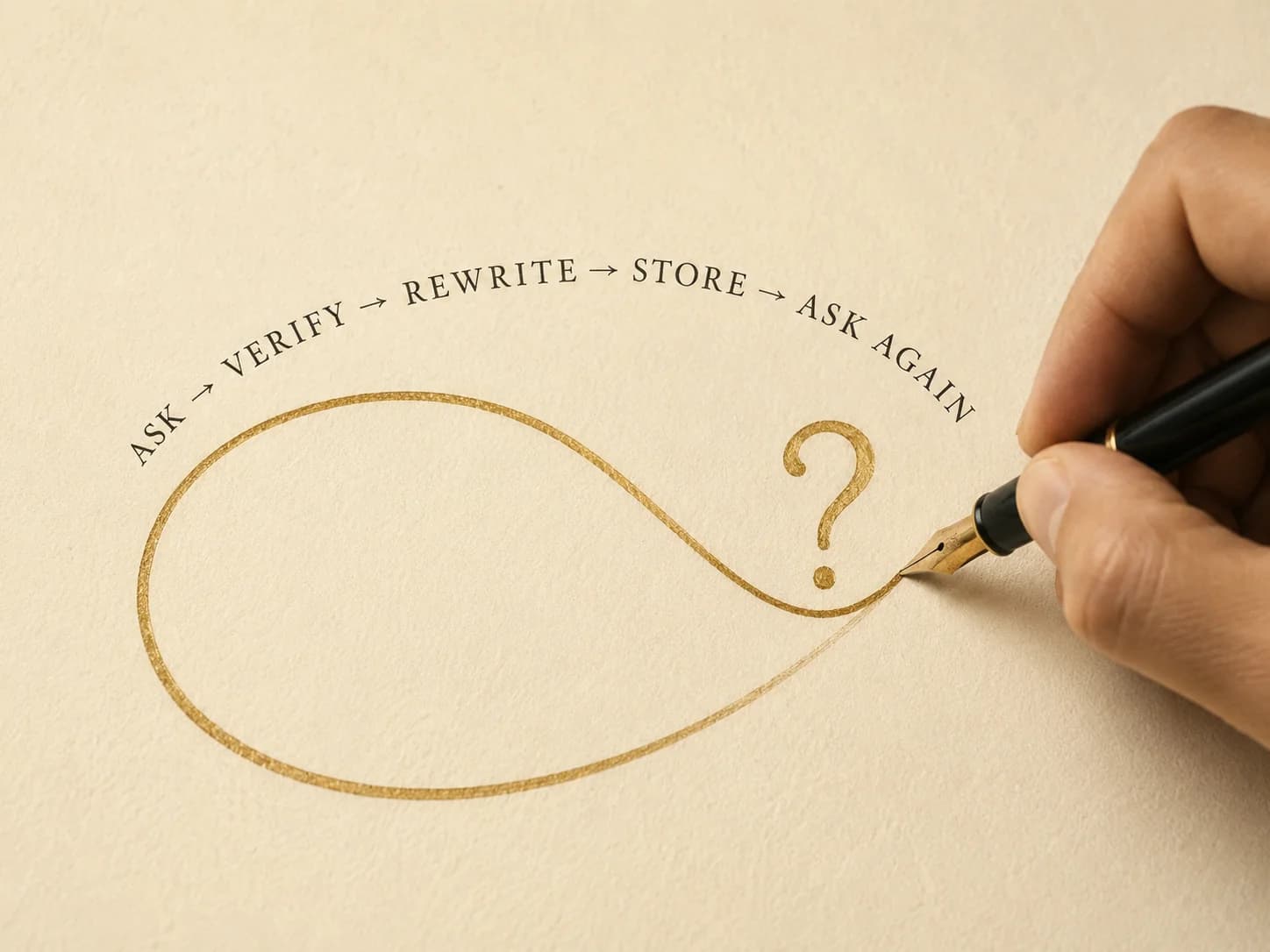
AI Learning Loop
There is a flow in which learning actually proceeds when learning with AI.
First, you ask a question. When you encounter an unfamiliar concept or hit a wall, you ask AI. At this point, rather than asking vaguely, a question that specifically reveals what you understand and what you don't know produces better results. "Explain X" produces a shallower answer than "I understand X this way, but I don't understand why this part seems wrong."
Once you receive an answer, you confirm your sense of understanding. Does your head nod? If so, the next question is needed. You pose questions that shake your understanding, like "If there's a part I misunderstood in this explanation, where is it?", "Show me a counterexample", "When does this concept not apply?"
Next, you compare with official documentation or actual code. You verify how what AI explained is specified in the official documentation and how it appears in actual code. If you find differences there, that difference becomes a new question.
You reconstruct it in your own words. If you've referenced both official materials and AI explanations, now you write down how you understand this concept in your own language. It doesn't need to be perfect. Points where you get stuck while writing become the next questions.
You keep a record of it. You save your own understanding written in your words, parts you haven't yet confirmed, and things to check next. Not in a chat window, but somewhere you can find it again.
And you ask again.
As this loop repeats, your understanding deepens. Each stage becomes material for the next stage. It's not completed in one go but formed through repetition. The loop itself is the learning.
There is one stage in this loop that is easiest to skip. The stage of "reconstructing it in your own words." When you've checked the official material, understood the AI explanation, and feel like you're done, you skip this stage. But without this stage, understanding doesn't internalize. The process of writing in your own language reveals what you don't know. The parts that don't flow smoothly are the parts not yet understood. If you simply copy the explanation you received from AI, this process is omitted. If you find it difficult to write in your own words, that difficulty tells you the direction of your next question. It's important to intentionally maintain this stage in the loop.
Four Recording Units
There is a minimum unit of record you should keep when studying with AI.
Question. What did I want to know? What concept was unclear? Where did I get stuck? By keeping this, when you encounter that concept again later, you don't have to start from scratch. Recording the question is recording what I don't know. It becomes a map of understanding itself.
Judgment. What am I temporarily believing now? What is my current understanding, even if it's not yet completely confirmed? You record the current state: "I understand it this way for now." Judgment can change. But by recording today's judgment, you can later compare how it changed.
Evidence. What did you see to make that judgment? Was it an AI explanation, official documentation, or results from directly running code? Keep both the source of evidence and its level of reliability. When you later review that judgment, you need evidence to question or verify it again. Judgment without evidence is hard to change later.
Unconfirmed. What should you not believe yet? What parts have not been verified? What is unclear about whether something only holds under certain conditions? It's important to mark these as unconfirmed. If you stack unconfirmed things as if they were confirmed, they later become material for mistaken judgments. Clearly marking the state of "still unknown" is also part of knowledge management.
When these four things are recorded together, the record becomes a structure you can revisit and think about, rather than simple storage.
In practice, applying this looks like this. Suppose you had a conversation with AI about indexes. If you kept these four things: Question — "I was curious why a query is slow even with an index." Judgment — "I understood that full scans can be faster when cardinality is low." Evidence — "AI explanation + confirmed optimizer behavior in MySQL official documentation." Unconfirmed — "Haven't yet verified when it makes sense to forcefully use index hints." Keeping these four things is much smaller than pasting an entire AI explanation into "index-notes.md," but far more useful later. The next time you encounter an index-related problem, seeing these four things tells you immediately where to start again.
Verification Questions
There are questions you can ask yourself after receiving an answer from AI.
Can you explain this answer in your own words? Close the book and imagine explaining it to someone else, checking where you get stuck. The point where you get stuck becomes the next question.
Where is this answer most likely to be wrong? You can ask AI directly or think of counterexamples yourself. Knowing where something can be wrong is knowing the boundaries of your understanding.
Have you compared it with official materials or real cases? Especially if it's something you'll actually use, you shouldn't skip this step.
Can you apply the same criteria even if the example changes? If you only understand based on the example AI gave, you might get stuck with a different example.
Where did you save this answer and can you find it again later? If you leave it in the chat window, you'll have to ask about the same thing again next time.
Has this answer changed your next action? If learning doesn't lead to actual action, that learning isn't yet complete.
You don't need to go through all these questions every time. But if a habit of checking even one of these develops, the quality of understanding rises alongside the speed of getting answers from AI.
The easiest one to start with is "Can you explain this answer in your own words?" After getting an answer from AI, close the screen and write what you just learned in a paragraph. If it writes well, that's a signal understanding has occurred. If you get stuck, the point where you stick becomes the next question. If you make this a habit, conversation with AI doesn't end at receiving an answer but concludes by confirming understanding. Rather than moving straight to the next conversation after getting an answer from AI, pausing briefly to check this one thing makes a difference in the quality of learning.
Stopping Conditions
When learning feels like it's going on infinitely, you need to know when you can pause briefly. For endless questioning not to become a means of avoiding judgment, there must be criteria for stopping.
You can stop when you've written down today's judgment. You can stop when you've marked unconfirmed parts as "unconfirmed." You can stop when you've determined what material to check next. You can stop when you've explained this concept in your own words for more than a paragraph. You can stop when you've decided on one real action based on this learning.
Stopping doesn't mean completion. It means you've made a judgment you can make today, left what you don't know in a pending state, and created a reason to come back next time. This is the rhythm of sustainable learning.
Questions are not an excuse to postpone conclusions but a process to make judgments more accurate.
One reason resistance to stopping arises is the anxiety: "Should I really stop even though there's still something I don't know?" But if you wait until there's nothing unknown to know, you can never stop. Learning is not completion but confirming your current position and determining the next direction. Making today's judgment creates better questions for tomorrow. That's why stopping isn't giving up but preparing for the next beginning.
Part 7. AI Does Not Replace Learning; It Makes the Responsibility of Learning Clearer
What AI Can Actually Help With
There are certainly things AI can substantively help with in learning.
It quickly grasps the outline of unfamiliar concepts. It significantly reduces the entry cost when starting from a state of knowing nothing. It's useful for figuring out where to look first.
It transforms abstract concepts into concrete scenes. It can create analogies from multiple angles and connect them with examples from different domains. When first grasping a concept, requesting various analogies helps find explanations that suit you.
It organizes lengthy content or structures relationships between concepts. When dealing with vast amounts of material, it's useful for grasping the overall context.
It validates your understanding when you articulate what you've learned. When you ask "Am I understanding this correctly?", it provides feedback on whether you're right or wrong. It becomes a conversation partner for verifying understanding.
When you ask "What cases does this concept not apply to?", it offers suggestions. It helps in testing and shaking your understanding.
When you ask it to create problems based on what you've learned, it does. It can be used as a tool for testing comprehension.
It can help you find related content in stored materials. Connected with RAG systems or personal wikis, it can speed up retrieving previously organized content.
These things can make learning more efficient. AI provides substantial help in creating learning materials, lowering learning barriers, and making repetition easier.
What's important here is that AI becoming better at all these things doesn't diminish the value of learning itself. Rather, the ability of people to handle these materials becomes more important. The more good materials there are, the greater the gap between those who know how to handle them properly and those who don't. When AI can provide similar materials to everyone, how those materials are utilized determines the quality of learning.
What AI Cannot Replace
But some parts of learning remain with people.
Deciding what to believe. When AI gives two different explanations, it's people who judge which one fits their situation better. It's people who understand the context, know the purpose, and know how it will be used.
Acknowledging what I don't know. When you ask AI, you get an answer. But good questions only come when you yourself understand where you're really stuck, which parts you still haven't grasped. That recognition cannot be done by AI.
Correcting when wrong. When you've accepted AI's explanation but later discover it was wrong, it's people who discard the existing understanding and replace it with new understanding. Through the pain of this correction, understanding becomes more solid.
Comparing with real materials. It's people who compare whether AI's answer matches actual official documents, actual code, actual data. AI can say comparison should be done, but the direct comparison is done by people.
Taking responsibility for what you've learned and using it. It's people who apply what they've learned to real situations and bear the consequences. Whether the results are good or bad, that experience leads back to learning.
Restating in your own words. The process of rewriting what you understand in your own language is an act of internalizing understanding. Copying what AI wrote for you is different from writing it yourself.
Discarding old judgments. When something you previously believed turns out to be wrong, it's people who erase it and establish new judgment. Updating old notes in storage as "this judgment has been revised" doesn't happen automatically.
Withholding unverified claims. Keeping unconfirmed content in a state of suspension rather than treating it as "correct for now" is a matter of awareness. AI doesn't automatically make this classification.
There's a pattern in this list. The things that remain for people in learning are mostly related to judgment. Believing, doubting, correcting, comparing, taking responsibility, suspending—these are all domains of judgment. And the common point in this list is one thing: they're all things AI cannot do automatically. AI can suggest. But people decide.
Learning Is Not Owning Answers; It Is Forming Judgment
If learning in the age of AI is summarized in one sentence, it's this.
Learning is less about owning answers and more about forming judgments.
Answers can be received. AI can give them. Explanations can be received. Summaries can be received. Put them in storage and you can retrieve them later.
But judgment must be formed.
Judgment is formed through questions. Through doubt. Through verification. Through application. Through being wrong and correcting. Through rewriting in your own words.
AI cannot replace this process. AI can become the material of this process, and it can speed up the process. But the process itself must be gone through by people.
Someone who has formed judgment has more than someone who has received an answer. They understand why that answer is correct, how far they can trust it, when they should doubt again. That understanding is learning.
There's another reason why forming judgment is different from owning answers. Judgment can be applied flexibly depending on circumstances. Understanding that a concept works "like this in this situation, and like that in that situation," varying by context, allows you to actually use that concept. Owning answers, by contrast, is memorizing in a specific form. If the context changes even slightly, you don't know if that answer is correct. You might think it's fine because AI can give you a new answer each time, but that's continually delegating judgment to AI. If you delegate judgment, the responsibility for acting on that judgment also becomes unclear.
AI can help with many aspects of learning. It explains, creates examples, answers questions, summarizes, organizes, and even creates practice problems. But it cannot replace learning itself. Because learning isn't about receiving answers; it's about the process of forming judgment from those answers.
Dechive's Perspective
AI creates answers. Dechive verifies those answers.
These two sentences are the starting point of this article.
This isn't saying to avoid AI. It's saying to create a structure where people can think again after receiving answers made by AI.
What Dechive pursues is not fast answers but verified understanding. The fact that AI explains well and the fact that AI's explanation is accurate are different things. The fact that AI summarizes well and the fact that that summary contains context are different things. The fact that AI can retrieve materials and the fact that those materials are verified are different things.
All these distinctions point in the same direction. The ability of AI to do something and the fact that the result is verified are issues at different levels. Trusting AI's capability and verifying AI's results are separate matters. Dechive doesn't deny AI's ability. It's saying we should transform AI's results into a structure where people can think again. That's the direction for learning together with AI.
The role that remains for people in learning hasn't disappeared. Rather, it has become clearer as AI becomes more widespread. The faster AI creates answers, the more important becomes the role of people who question and verify those answers again.
Learning responsibility in the age of AI hasn't decreased; it has changed. Unlike the era when we had to find books and attend lectures, now we receive answers quickly. But the work of turning those answers into my own judgment still falls to people. In a sense, this responsibility has become more distinct. Previously, the verification structure of books or lectures filtered things somewhat. Now AI's answers come directly without that filter. As the filtering decreases, the importance of judgment increases.
AI does well at creating learning materials. People must take responsibility for learning.
The importance of this distinction is not to deny AI's role but to use AI's role more clearly. To work with a tool that makes materials well, you need to know how to handle those materials. An explanation created by AI is learning material. The process of doubting, verifying, and making it your own is learning. Being good at learning with AI doesn't mean receiving more answers from AI. It means handling the materials created by AI better.
Summary — Learning Doesn't End; It Becomes Possible to Question Again
When AI gives an answer, learning seems to end.
You asked a question, an answer came, and the sense that you understood arrives. It seems finished.
But genuine learning begins when the answer generates questions again.
"Where in this explanation do I still not know?" "What conditions are necessary when this answer is actually applied?" "How are this concept and that concept connected?" "When could this answer be wrong?"
The fact that these questions arise is a signal that understanding is deepening. At first, you can't ask questions because you know nothing. Once you know a little, you can ask more precise questions. The better you understand, the sharper the questions become. The change in quality of questions is evidence that understanding has deepened.
A state where learning has ended is not a state where there are no more questions. Rather, a state where you can question this concept again, doubt it again, and connect it with other concepts is a state where learning is alive.
Even if AI retrieves knowledge from my storage, if I cannot ask new questions about that knowledge, learning has stopped. Conversely, even with incomplete understanding, if new questions follow from it, learning is continuing to move.
AI creates learning materials. But the responsibility of learning remains with people. That responsibility is not heavy. It's the process of making what you've learned truly your own. The process of questioning, doubting, verifying, and rebuilding.
Learning in the age of AI is not about collecting more answers. It's about keeping answers in a state where they can be questioned again. When that state is maintained, learning accumulates and understanding deepens.
Questions are not an end but a sign of being alive.
Learning in the age of AI appears easier but demands something more difficult. Because answers can be obtained easily, you must more consciously question, verify, and make those answers your own. The fact that AI creates learning materials faster means the role of the people handling those materials has become more important.
In an era when it's easiest to mistake receiving an answer for learning, we need to understand more clearly what real learning is. The more answers AI gives, the more important becomes the ability to transform those answers into your own judgment. That is the core role of learning that remains for people in the age of AI.
Am I receiving more answers from AI, or am I transforming those answers into my own judgment by questioning and verifying them?