Is Data Analysis Only Necessary for Corporations?
This article examines whether data analysis is merely a technology needed for corporate dashboards and reports, or whether it represents a way of thinking essential for verifying individual judgment and decision-making in the AI era.
I started thinking about this question while talking to people who do data analysis work.
Is data analysis really just a corporate function?
Looking at sales figures, tracking advertising performance, analyzing customer churn, staring at BI dashboards. In those scenes, there's always a corporation. There's an analytics team, large spreadsheets, customer databases. There doesn't seem to be room for individuals.
But in the AI era, individuals keep making choices.
What to write, what to create, which direction to push. How do you verify whether those choices actually worked? Is intuition enough? Or do you need to read something?
And the more quickly AI makes those choices for you, the more frequently this question comes up. Did the direction AI recommended actually work? Did the keywords AI picked really connect with your audience? Was the automation AI proposed actually effective? You can't ask AI these things again. You have to look at what remains as a result in the real world.
This piece starts from that question.
The purpose of this piece is to deeply examine whether data analysis is a specialized corporate skill or also a way of thinking to verify individual judgment. It's not about tool usage. Not about SQL syntax, not about GA4 installation, not about how to use Excel pivot tables. It digs all the way into where the mindset of data analysis comes from and why it's now necessary for individuals too.
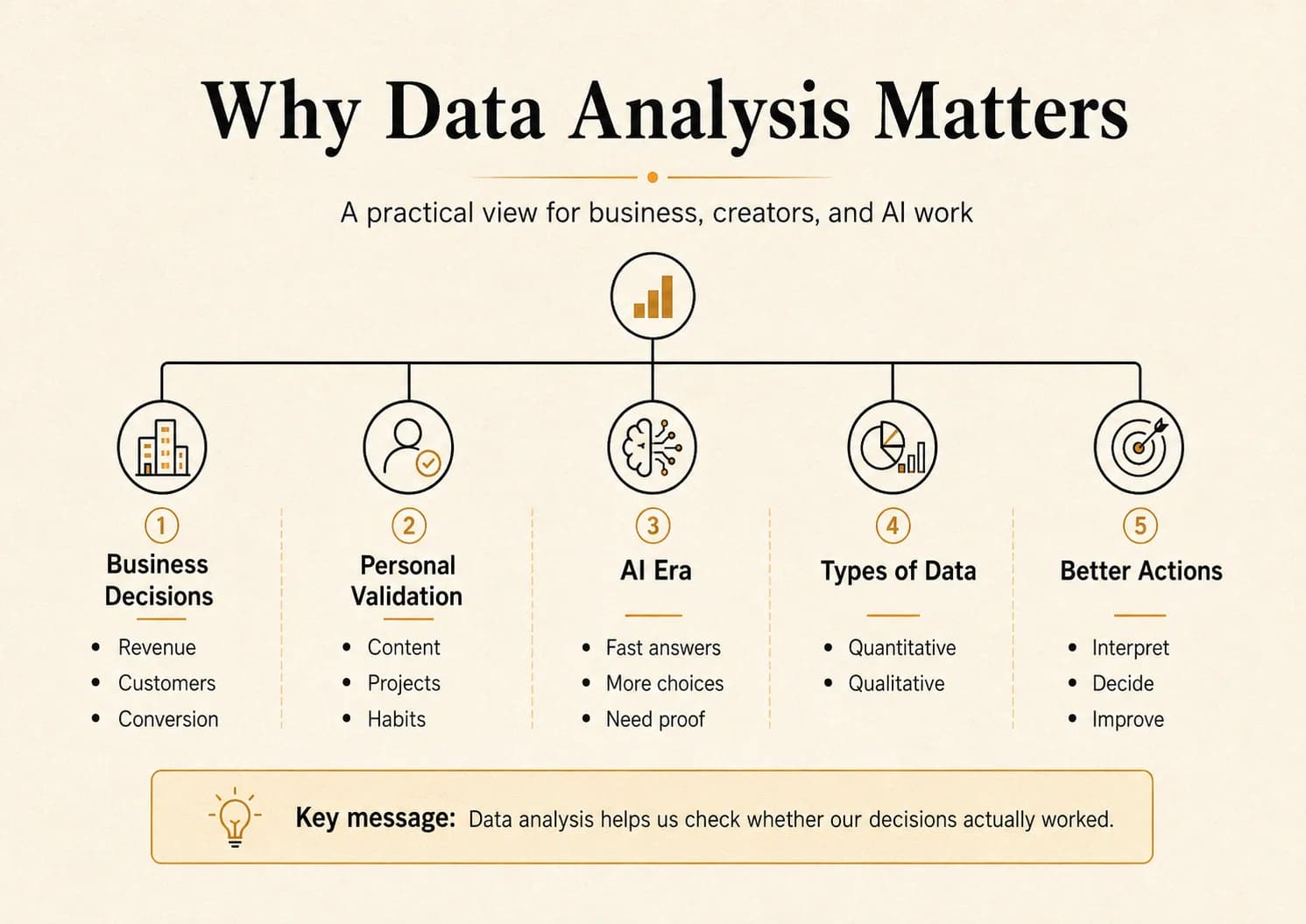
This structural map is less of a table of contents for this piece and more of a map for how to view data analysis. It contains the flow of expanding data analysis from corporate dashboards to individual choice verification and AI-era judgment issues.
1. Why Does the Term "Data Analysis" Feel Difficult?
The barrier that people encounter when they first approach data analysis comes from tools.
SQL. Python. R. Tableau. Power BI. GA4. BigQuery. A/B Testing. Statistical significance. Regression analysis. Machine learning.
When all these terms come to mind at once, data analysis suddenly looks like an expert's domain. It feels like a technique that is difficult to access without a specialized background and impossible to use without years of training.
But these words are simply names of tools. Tools and ways of thinking are different things.
When learning to drive, you don't start by studying engine structure. First comes deciding where to go, why you're going, and which route is better. Tools come after that.
Data analysis is the same. First comes understanding what question you want to answer, what judgment you want to verify, and what signals you need to read. Tools are something you pick and use as needed afterward.
There is one point that is easy to misunderstand. Saying "I do data analysis" does not necessarily mean "I create dashboards" or "I use SQL." The essence of data analysis is closer to an attitude than a tool. It's the attitude of looking at the results left behind in reality and checking where your judgment was right and where it went wrong.
Looking at it more specifically, there are three levels.
The first is data analysis as a technique. SQL, Python, BI tools, statistics. This is a specialized field.
The second is data analysis as a job. The work that data teams do in companies—creating reports and deriving insights.
The third is data analysis as a way of thinking. The attitude of confirming what results your choices actually created. Looking at your judgment again through records rather than feelings.
This article focuses on the third level. If you adopt this way of thinking before learning tools, you can use any tool better.
Verification Questions
- Am I only understanding data analysis through tool names?
- Am I thinking of tools before the question I want to answer?
2. What is Data?
Before discussing data analysis, we need to clarify what data is.
Data is not just numbers.
When people think of data, they often imagine rows of numbers in an Excel spreadsheet. 1,203 views. 3.2% conversion rate. 2 minutes 47 seconds of time spent. But these numbers are only part of data.
Data is a trace left in reality.
A record that someone clicked a button, a trace that a reader stopped scrolling at a certain point in an article, a pattern that a customer dropped off at a specific sentence, what actually happened when an AI recommendation was followed—all of this is data.
When data is divided by type, its structure becomes clear.
Numerical Data
Views, clicks, purchase amounts, error counts, task duration, character count, response speed. These can be measured accurately and aggregated. They are easy to compare and easy to find patterns in. But without context, they are meaningless.
Text Data
Comments, feedback, search queries, inquiry contents, personal notes, conversation records. Meaning that cannot be compressed into numbers is contained within them. Because they exist in human language, interpretation is required. But they often contain signals that numbers cannot capture.
Behavioral Data
Which page was visited, in what order things were clicked, which feature was used first, where someone stopped and left. These are traces left by human action without having to say anything directly.
Log Data
Events automatically recorded by a system. Access times, error records, server response speeds, executed commands. Especially for people operating automation, log data is important information showing whether the automation actually ran and where it failed.
Quantitative and Qualitative Data
The most important distinction when dividing data into two broad categories.
Quantitative data is data measured in numerical form. How much, how many times, to what extent. Comparison and tracking are easy. Views increased by 20% compared to last week from 1,000. Time spent increased from an average of 3 minutes to 5 minutes.
Qualitative data is data that cannot be completely compressed into numbers. What readers said in comments, the tone of feedback, direct reactions about what parts resonated, records individuals left themselves. It accumulates more slowly than numbers, but sometimes shows what numbers cannot.
Explicit Data and Implicit Data
Explicit data is what people directly expressed. Ratings, comments, survey responses, reviews.
Implicit data is what people unintentionally left through their actions. Which links were clicked, which articles were spent more time on, which product pages were visited repeatedly.
Implicit data is sometimes more honest than explicit data. A person may write "satisfied" on a survey, but may never actually return to that service.
The Difference Between Data and Opinion
"This article is good" is an opinion. "This article has an average time spent of 6 minutes and a 23% return visit rate" are numbers that come from data. Opinion is one perspective. Data is a trace of what actually happened.
But data is not complete truth either. Data is a record of part of reality, not the entirety of reality. This point will be discussed in more detail later when covering pitfalls.
Data and Noise
Not all data is signal. Data contains a mixture of signal and noise.
Signal is change that has a pattern and meaning. When articles on a specific topic repeatedly record high time spent is a signal. When errors consistently decrease after implementing a specific automation, that is also a signal.
Noise is change that is temporary or close to coincidental. If views suddenly tripled one day and then returned to normal the next day, it is likely noise.
Distinguishing signal from noise is one of the core techniques in data analysis. To do this, you need data from a sufficient period of time, and you must check whether the change repeats.
The Relationship Between Data and Record
What is not recorded is difficult to verify later.
If I rely only on memory about what articles I wrote last month and what reactions there were, memory tends to remember moments that went well more strongly and overlook moments that did not. For the same reason, if there is no record of what actually resulted when following an AI recommendation, there is no way to compare it next time.
Data is material for judgment, not judgment itself. But without material, judgment becomes much less accurate.
Personal Data Begins with Record
Data can accumulate even without analysis tools. The simplest way to start is with recording.
After writing an article, jot down in one line what reaction there was. Write down what happened when following an AI recommendation. Record the date an automation was implemented and the changes that followed.
These records later become data. As records accumulate, patterns emerge. When patterns emerge, the next choice changes.
Data analysis does not start with grandiose tools. It starts with leaving a record of reality.
Verification Questions
- Is what I call "data" actually a trace left in reality, or is it my impression?
- Am I keeping records of feedback that cannot be aggregated into numbers?
3. What Does Data Analysis Do in a Business
The reason companies conduct data analysis is simple.
To verify the results of their choices.
Companies make choices every day. Which ads to run, which features to develop, which prices to set, which channels to invest in, which operational methods to adopt. If companies don't verify what results these choices actually produced, the next choice will repeat the same mistakes.
Data becomes the material for that verification.
Looking specifically at the areas that data analysis actually handles in companies, the scope is broad.
Sales Analysis
Did this month's sales go up or down compared to last month. Which products, through which channels, and from which customer segments generated sales. If sales increased, was it due to new customers, increased purchases from existing customers, or price changes. If they decreased, where did the drop occur.
Behind one number called sales are dozens of questions. Data analysis is the process of answering those questions.
Customer Analysis
Who is buying. Where do they come from. Do they buy only once, or do they make repeat purchases. Which customers stay longer. Which customers leave negative feedback. Which customer segments respond to specific products.
This is why understanding customers should come before increasing sales. If you don't know who is buying and why, you can't know what to improve.
Ad Performance Analysis
You spent ad budget, but did it actually lead to purchases. Were there many clicks but few purchases. Which channel actually brought real customers. Which ad creative got better response. Is the cost-to-performance ratio sufficient.
A common error in ad analysis is the conclusion that "many clicks means a successful ad." There are many steps between clicks and purchases. If clicks are high but purchase conversion is low, the problem might not be the ad but the landing page or pricing.
This situation actually happens. You launched a new ad campaign. The click-through rate went up 40% compared to before. The team judged it a success. But when they checked the purchase conversion rate, it was actually lower. Clicks increased, but the customers actually converting to purchases decreased.
What changed. The new ad generated more interest, but it attracted more people who were simply curious and clicked rather than people with actual purchase intent. Click-through rate and conversion rate are different signals. Looking only at clicks versus looking at the flow after clicks creates completely different judgments.
Product Usage Analysis
Which features do users use frequently. Which features are barely used. Where do errors occur frequently. In what order do users explore the service. Do they come back within a week after first use.
Sometimes features that the product team considered important are ignored by users. Conversely, features made as side additions sometimes become core features for users. Without looking at data, it's hard to know this difference.
Churn Analysis
Where do customers leave. Right after signup. After their first purchase. Do they drop off repeatedly at a specific stage. What characteristics do churned customers have. What actions did they take just before churning.
Churn analysis is used not just to retain customers but to understand what went wrong. The churn point is a signal showing the weak parts of the service.
Operating Cost Analysis
Which processes take the most time. Which tasks create repeated mistakes. When automation was introduced, did costs actually decrease. Did costs go down while quality remained.
Operations analysis is inward-facing analysis. It looks at the way work itself is done, not customers.
A/B Testing
A method that directly compares which of two approaches produces better results. Does changing the headline increase click-through rate. Does changing button color affect conversion rate. Does changing email send time affect open rate.
A/B testing is a way to reduce assumptions and verify directly. However, if you draw conclusions before sufficient samples are collected, you might mistake chance for pattern.
Retention Analysis
The ratio of users who return to use the service after a certain period from first use. If 30-day retention is 10%, it means that of 100 first-time users, 10 are still using the service 30 days later.
Retention is a metric that shows the long-term value of a service. Even if new user acquisition is high, low retention signals that people are using the service then quickly leaving.
Funnel Analysis
Breaking down the path users take from initial contact to final goal by stage. Visit → Sign up → Browse products → Add to cart → Purchase complete. At each stage, confirm what percentage moves to the next stage.
Funnel analysis is useful for finding which stage loses the most people. Improving that point is the most effective way to increase overall conversion.
VOC Analysis (Voice of Customer)
Systematically reading inquiries, reviews, and complaints that customers left. What keywords appear repeatedly, in what situations complaints arise, which features or services receive frequent requests.
VOC contains the actual language of customers in ways hard to see through quantitative data alone. If reviews saying "shipping is slow" repeat, before improving shipping metrics, you may need to reconsider the entire shipping experience.
Cohort Analysis
A cohort is a group of users sharing specific conditions. For example, tracking whether users who first signed up in May continue using the service in June and July is cohort analysis.
Cohort analysis reveals differences that averages hide. Even if overall retention is stable, if users who signed up during a specific period have unusually high churn, you can track what happened during that time. It helps separate product changes, marketing message changes, and seasonal effects.
Inventory and Supply Chain Analysis
In manufacturing, distribution, and commerce sectors, inventory data is critical. Which products are consumed quickly. Which products pile up. Are there seasonal demand changes. Are there patterns in supplier delivery delays.
Inventory analysis connects to demand forecasting. The goal is to read patterns from past data to predict future demand and maintain appropriate inventory levels.
Data Analysis Application by Industry
Even for the same corporate data analysis, the metrics companies watch vary by industry.
E-commerce (Online Shopping):
- Cart abandonment rate: The ratio of products added to cart but not purchased. Used to find issues with price, shipping cost, and payment convenience.
- Repeat purchase rate: The ratio of the same customer making more than one purchase. Shows customer loyalty.
- Sales trends by category: Which categories are growing.
SaaS (Software Service):
- Active users (DAU/MAU): The number of people actually using the service daily or monthly.
- Feature usage rate: Which features are actually used and which are barely used.
- Upgrade conversion rate: The ratio and timing of free users converting to paid.
Media/Content:
- Completion rate per article/video: How many people read or watched to the end.
- Returning reader ratio: If someone comes once, do they return.
- Search traffic keywords: What keywords bring people in.
What emerges from this industry difference is this: While what each industry seeks to verify through data analysis varies depending on service type, the underlying structure of asking "Did this choice actually create value" is the same.
The common point in all these analyses at companies is one thing.
A choice was made, and the result of that choice is verified.
Companies don't look at data for the sake of looking at data. They look at data to verify how the decisions they made actually worked in reality.
4. Core Questions in Business Data Analysis
In business, data analysis is not about creating reports. It is about understanding what happened now in order to make better choices next time.
There are recurring questions that appear throughout this process.
4.1 What happened
The first is grasping the current situation.
What was this month's revenue? How many visitors were there? What is the conversion rate level? Has customer churn increased or decreased?
These questions seem simple but cannot be skipped. If you don't accurately grasp the current situation, it's difficult to notice changes even when they occur. "Things seem to be going well" and "this month's return visitor rate dropped 15% compared to last month" create entirely different starting points.
When grasping the current situation, pay attention to the time unit used to view numbers. Looking at daily data causes you to react to very small fluctuations. Looking at too long a period means you discover important changes too late. You should choose comparison benchmarks—week-over-week, month-over-month, year-over-year, etc.—to match your purpose.
Personal example: Blog views suddenly doubled this week. Before getting excited, I first look at why it went up. Was a specific post shared somewhere? Is it a seasonal effect? Is it temporary traffic? Is it because I'm actually doing well? If you don't identify which of these it is, you'll be disappointed when it returns to normal levels the following week.
Distinguishing Trends from Anomalies
A trend is a directional, sustained change. If return visitor rates increase slightly each week, that's a trend.
An anomaly is a temporary spike or drop. If traffic suddenly increased 10 times on a particular day, that's an anomaly. You need to find the cause first.
If you don't distinguish between trends and anomalies, you either overreact to anomalies or miss meaningful trends. When looking at data, it's good to first distinguish whether "this is a direction or a temporary change."
4.2 Why did it happen
The second is cause exploration.
Once you know revenue decreased, you need to see why it decreased. Did new customer acquisition drop? Did purchase frequency among existing customers decline? Did it decrease only in specific product categories? Did inflow from a specific channel stop?
Cause exploration is difficult. This is because many variables often change simultaneously. If this month you reduced advertising, at the same time a competitor started discounting, and there was also seasonal change, it becomes difficult to isolate which is the main cause of the sales decline.
This is why it's important in cause exploration not to confuse correlation with causation. Just because two numbers move together doesn't mean one causes the other. This will be covered in more detail in the pitfalls section.
4.3 Is this change coincidence or a repeating signal
The third is distinguishing signal from noise.
Revenue increased 20% this week. Is this a good signal or just temporary fluctuation? Dwell time suddenly increased. Did the content improve, or did loading speed slow down?
A single data point is difficult to serve as evidence. You can only call something a pattern when repetition appears. This is why it's important to separate short-term fluctuations from long-term trends.
Seasonality also belongs to this category. Certain industries have patterns where revenue increases during certain seasons. If you don't account for this, you can mistake seasonal effects for the results of your strategy.
4.4 What choice created this result
The fourth is connecting choice to outcome.
You launched a new feature. At the same time, user return rates increased. Does the increase in return rate result from the new feature? Or is it from the marketing campaign running at the same time? Or is it an external seasonal factor?
To answer this question, you need to control variables. It's best to change one thing at a time and compare results. This is why companies use A/B testing. When you change multiple things simultaneously, it becomes difficult to know which one created the result.
Personal example: This month I changed the topic of posts, changed the publishing day, and changed the title style, and views increased. Since three things changed simultaneously, I can't tell which was effective. Next time, changing one thing at a time and comparing results will create more accurate judgment.
4.5 What should we change next
The fifth is deciding on the next action.
Analysis should ultimately converge on this question. You looked at data and created a report, so what will you change?
One reason analysis fails in business is when the report is well-made but nothing actually changes. If analysis doesn't connect to decision-making, data remains just a pile of numbers.
Analysis → judgment → action → analysis again. This cycle is necessary for data analysis to have meaning.
It's the same for individuals. You looked at data and kept records, but if the direction of your next post didn't change because of it, that analysis is incomplete. The purpose of analysis is not to discover insights but to make your next choice more accurate.
Verification Questions
- What decision is the number I'm looking at connected to?
- Has the analysis been completed but nothing has changed?
5. How Data, Metrics, and KPIs Differ
There are words that get mixed up when talking about data analysis. Data, metrics, KPIs, and metrics. Distinguishing these concepts makes analysis clearer.
Data
The most basic unit. A record of a user clicking a certain button at a certain time. It is raw material in itself. It is a state before interpretation is added.
Metric
A measured value created by aggregating or calculating data. Click count, average session duration, bounce rate, return visit rate. Multiple data points compressed into a single number.
Metrics are useful but require caution. A metric shows part of reality but not the whole. The moment you choose a metric, you determine what you will see and what you will miss.
KPI (Key Performance Indicator)
Key performance indicator. Among multiple metrics, it refers to the metric most directly connected to your current goal. When the goal changes, the KPI changes too.
For example, if the goal is acquiring new users, the number of new visitors could be a KPI. But if the goal is user retention, 30-day retention becomes the KPI. Even in the same service, the KPI changes depending on what stage you're at.
More KPIs are not always better. Too many KPIs blur where you should focus. A good KPI is a core metric that best reflects one goal.
Conversion
The occurrence of a goal action. A visitor made a purchase, subscribed, signed up, or opened a specific page. What you define as conversion depends on your goal.
Conversion rate is the proportion of people who took a specific action. If 5 out of 100 visitors make a purchase, the conversion rate is 5%.
The conversion concept also applies to individuals. The ratio of people who read an article and subscribe to a newsletter. The ratio of people who viewed a specific topic article and read other articles too.
Churn / Bounce
Users leaving your service or content.
Bounce rate has different meanings depending on context. In a single-page service, a high bounce rate might mean users achieved their goal and left. In a multi-step service, a high bounce rate might mean they're stuck at a specific step. Without context, it's easy to misunderstand bounce rate alone.
Retention
Users continuing to use the service after a certain period. D1 retention is the ratio returning the day after first use, D7 is after 7 days, D30 is after 30 days.
Retention shows whether your service provides continuous value to users. Even with high new user acquisition, low retention is like pouring water into a leaky bucket.
Funnel
A structure dividing the process of users reaching a specific goal into stages. The shape with many entering at the top and decreasing toward the bottom resembles a funnel.
The purpose of funnel analysis is to find the point where dropout is highest between each stage and improve it.
How Do These Concepts Apply to Individuals
If you run a blog, you could look at it this way.
Data: View records of a specific article, click logs. Metrics: View count, session duration, bounce rate. KPI: If your current goal is "articles that are read longer," then session duration is the KPI. If your goal is "acquiring returning readers," then return visit rate is the KPI. Conversion: A reader who read your article also reads other articles, or subscribes to your newsletter. Retention: Did a reader who came a month ago also come this month?
On Dechive, what is a more important metric than view count? Records that remain long-term, search traffic, return visits, potential for future citation. These might be more important metrics than simple view count but are harder to measure.
Segment
A group of users or data divided by specific criteria. Dividing by segment shows more than looking at the overall average.
Company example: By dividing new and existing users, you might find that certain features are important to new users while different features matter to long-term users.
Individual example: Session duration might differ between readers from search and direct visitors. Readers coming from search came looking for specific information, while direct visitors came to read the article itself. When viewing these two groups together, the meaning of session duration changes.
Dividing segments further makes differences more apparent. First-time readers, returning readers, readers from SNS, readers from search, readers coming from other articles. These people have different purposes even when viewing the same article. The overall average session duration bundles these groups together, but dividing them reveals a different picture of how different readers connect with your article in different ways.
Overall average bundles readers into one, but segments divide people who came for different reasons back apart.
North Star Metric
A single core metric that drives an entire organization or project in one direction. All decisions are aligned based on this single metric.
A good North Star Metric reflects whether actual value has been delivered to users. YouTube's watch time, Spotify's music play time, Airbnb's booking completion count.
The advantage of North Star Metric is that it unifies direction. When teams look at different metrics, priority conflicts arise. Sharing one core metric makes it clear what you're working for.
Applying North Star Metric to individuals, you could ask: What is the one most important metric for the blog I operate? Is it view count, return visit rate, session duration, or newsletter subscriptions? Once you choose that one, other decisions have a benchmark.
Choosing a metric itself is already a judgment. It is the act of expressing what you value as important in numbers.
Leading and Lagging Indicators
There is another useful distinction when understanding metrics.
A lagging indicator is a metric you check after results appear. Revenue, view count, conversion count, subscriber count. It shows what has already happened. Accurate, but a signal that has already passed.
A leading indicator is a metric that shows direction before results appear. Saves, return visits, focus on specific articles, increased usage frequency. Even if the numbers aren't large yet, they can be signals that you're heading in the right direction.
Using a blog as an example, subscriber count or revenue are lagging indicators. Increasing return visits on articles about specific topics, rising saves, readers leaving comments or questions can be leading signals. Even if subscriber count is still low, if you see these leading signals, there's a chance you're on the right track.
Lagging indicators show results; leading indicators show direction.
Easy-to-misunderstand point There's a misconception that achieving a high KPI means accomplishing your goal. But a KPI is a proxy metric for your goal. Even when a KPI rises, the original goal might not be fulfilled. If session duration grew longer but readers became confused, causing longer duration, then the session duration KPI is up but your actual goal of "understandable writing" isn't achieved.
6. Basic Flow of Data Analysis
When you understand the overall structure of how data analysis works, you can see that corporate analysis and personal analysis essentially have the same structure.
The basic flow is like this.
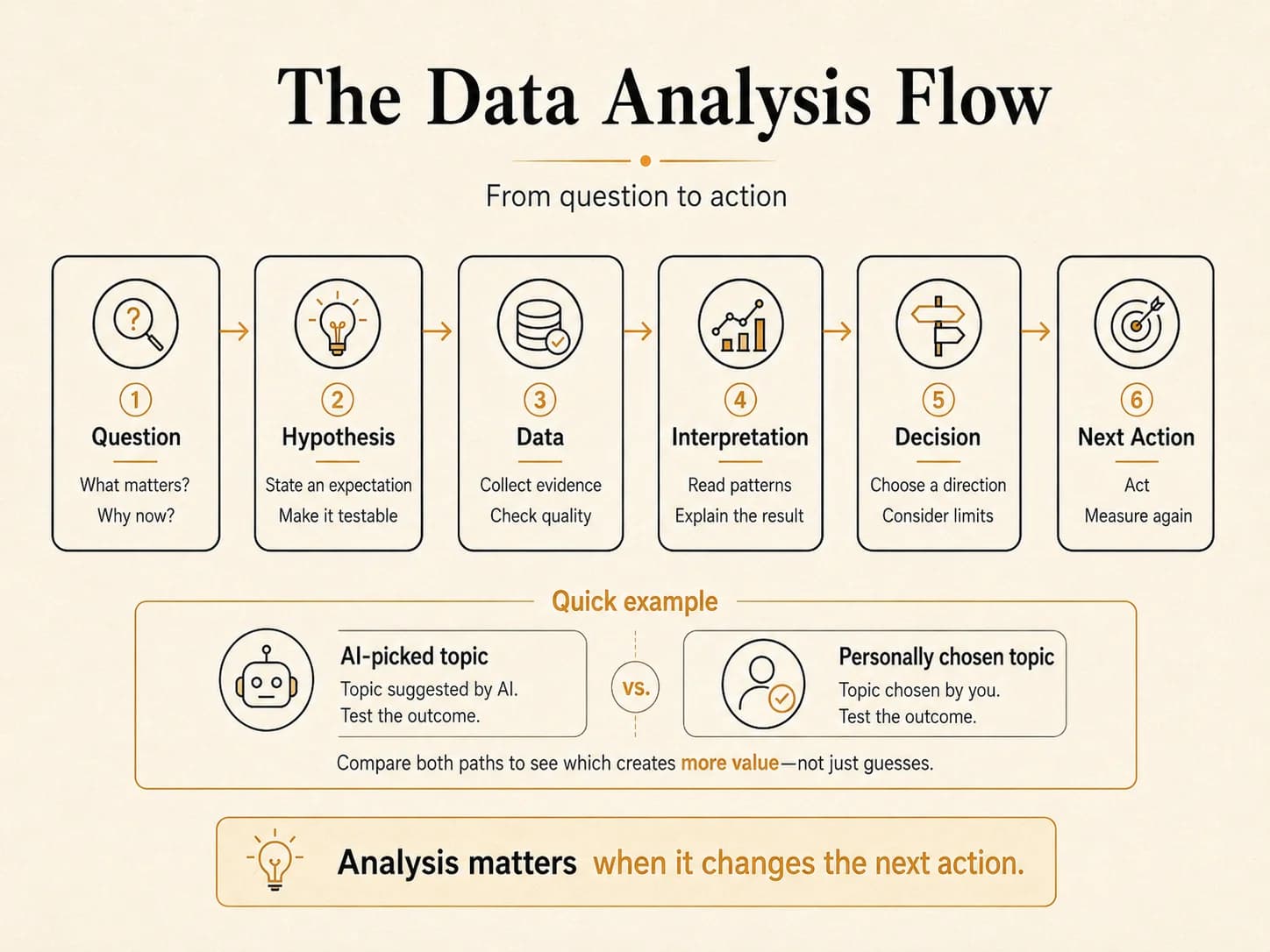
The most critical point in this flow is the final 'next action.' Analysis does not end the moment you see numbers. Analysis only truly happens when your next choice changes.
Question → Hypothesis → Data → Interpretation → Judgment → Next Action
This cycle does not end in a single round. The next action creates a new reality, and a new question emerges from that reality. Data analysis is a repeating cycle.
Some people turn this cycle quickly and frequently, while others turn it slowly and rarely. You cannot say which is better. But if the cycle does not turn, even with data, your choices will not change.
When you see actual examples of this flow in action, you understand it more concretely.
Time Units in Data Analysis
Depending on what time unit you view the same data in, what you see changes.
Daily data: It's easy to overreact to small fluctuations. You shouldn't change direction just because today's view count was low. Daily data is best used for detecting anomalies.
Weekly data: It's suitable for viewing short-term trends. If a specific post got good engagement this week, you can explore why.
Monthly data: It's good for confirming direction. Overall, what direction was effective this month?
Quarterly data: It's used for seeing the big picture. What strategy created results in three-month increments?
Individuals also benefit from distinguishing between these time units. Looking at numbers every day and worrying is different from confirming patterns on a weekly basis. A routine where you respond less to daily numbers, look at weekly patterns, and confirm monthly direction is more stable.
Example: I wrote an article on a topic recommended by AI
Question: Do articles written with keywords recommended by AI get read longer than articles on topics I chose directly?
Hypothesis: The keyword AI recommended has high search volume, so more readers will read it for longer.
Data: Average reading time for 3 AI-recommended topic articles vs. average reading time for 3 directly chosen topic articles.
Interpretation: The AI-recommended topic articles had an average reading time of 2 minutes 30 seconds, while directly chosen topic articles were 5 minutes 10 seconds. However, the AI-recommended topic articles had higher view counts. They had higher views but shorter actual reading time.
Judgment: AI-recommended keywords helped with discovery, but articles where readers stayed longer were on topics I chose directly. Discovery and depth can be different.
Next action: Use AI-recommended keywords in the title, but write the body on topics I can actually explore in depth. Separate strategy by dividing discovery potential and content depth.
This is a completed cycle. And after the next action, when new data accumulates, the questioning starts again.
Let's look deeper into each stage.
6.1 Question
All analysis should start with a question.
If you start looking at data without a question, you wander through numbers without knowing what to find. Conversely, if the question is clear, it naturally becomes obvious what data you need to see.
There is a difference between bad questions and good questions.
Bad question: "What's the view count?"
This question is confirming a number, not understanding something. Without a judgment to make based on the view count being 1,000, it's not a question—it's a check.
Good question: "What topic articles make readers stay longer?"
This question makes you look at reading time instead of view counts, and classified topics instead of all articles. When you get an answer, it leads to a judgment about what topic to write for the next article.
The question determines the metrics. What question you ask decides what data you will see.
6.2 Hypothesis
A hypothesis is first writing down what you expect to happen.
Without a hypothesis, it's easy to make results fit after the fact. Seeing a high-view article and then thinking "this topic is indeed good" is interpreting the result without a hypothesis. If you first set a hypothesis like "this topic's article will have a long reading time" and confirm it with data, it's much more accurate.
It's okay if the hypothesis is wrong. Discovering that your hypothesis was wrong is also important information. Finding out that the direction you thought was good was not actually so for readers becomes the starting point for changing your next choice.
6.3 Data
When you have a question and hypothesis, it becomes clear what data to look at.
You don't need to look at all data. First look at data closest to your question. Looking at too many metrics simultaneously can actually create confusion and cause you to miss important signals.
The unit in which you view data is also important. Viewing data daily can cause overreaction to daily fluctuations. Looking at too long a period causes you to miss recent changes. It's good to use weekly, monthly, and quarterly units in combination depending on your purpose.
6.4 Interpretation
Getting numbers doesn't mean analysis is finished. Interpretation is necessary.
Interpretation is attaching context to numbers. The same number can have completely different meanings in different contexts.
Reading time of 8 minutes. Readers might have read the article deeply. Or the article might have been so complex it took time to understand. You cannot know from numbers alone.
Human judgment enters into interpretation. Data gives signals, but it is humans who decide what those signals mean. This is one reason why data analysis is hard to automate.
6.5 Judgment
Based on interpretation, make a decision.
Do you continue? Do you change direction? Do you pause and observe more? This is also part of data analysis.
When making judgments, don't expect data to tell you everything. Data is a trace of what happened in the past. It is the person who read that trace who decides what to do next. Data does not replace judgment.
6.6 Next Action
Once judgment is made, your next action should change.
If analysis ends only as a report and nothing changes, it's not analysis—it's a record. The meaning of data analysis lies in your next action changing. What topics you should write more about, what automation you need to change, what directions you should abandon.
This action creates a new reality again, and a new question emerges. The cycle continues.
Verification Questions
- Did my analysis start with a question, or did I start by looking at numbers?
- Did I write the hypothesis first, or did I create an interpretation after seeing results?
- After analysis, did my next action actually change?
7. How Are Corporate Data Analysis and Personal Data Analysis Different?
It would be an overstatement to say that corporate and personal data analysis are the same. But it would be missing the essence to say they are completely different.
The differences lie in scale, tools, and scope of responsibility. But the essence is the same: verifying the results of your choices.
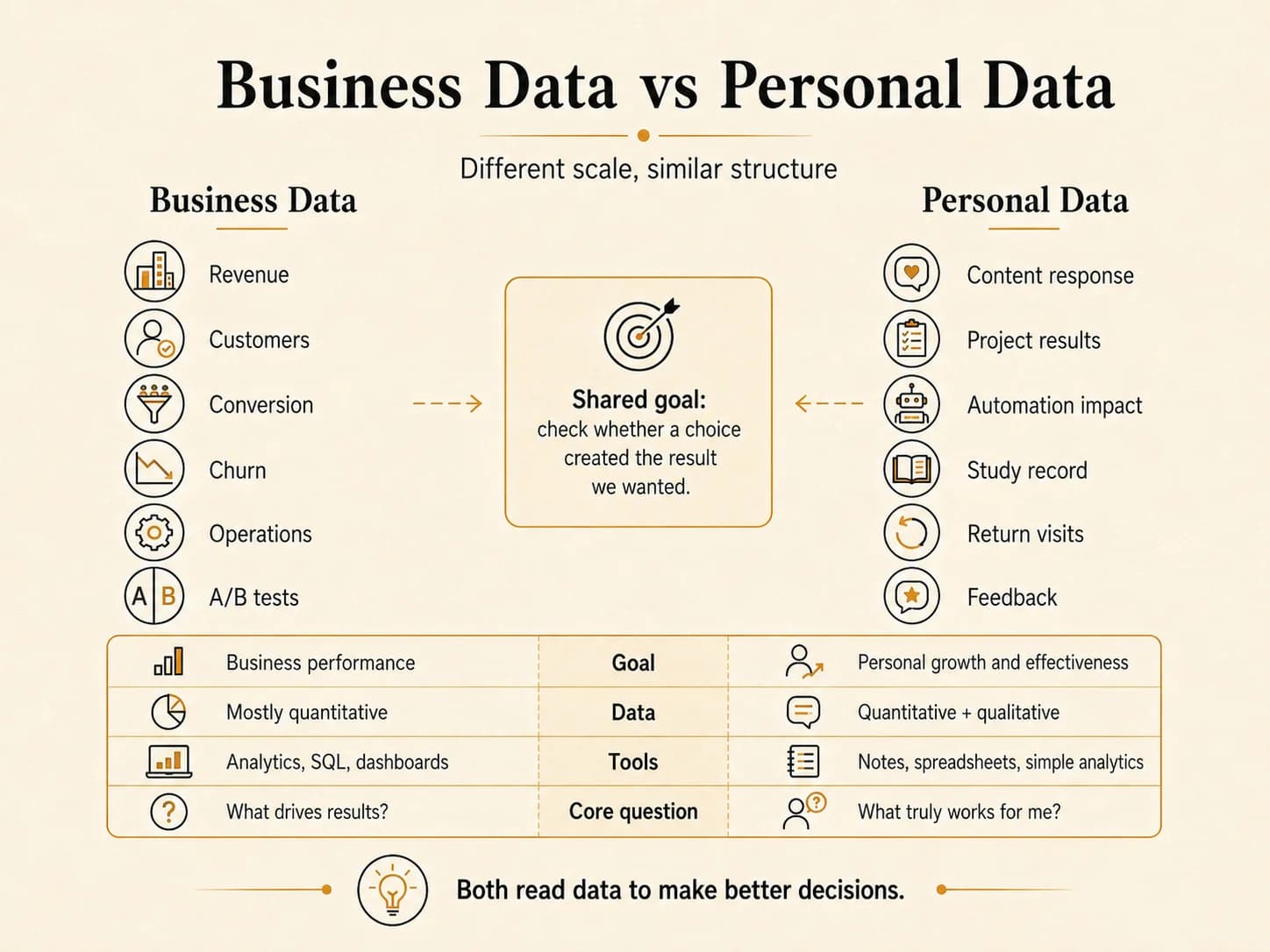
This comparison image does not mean that corporate and personal analysis do the same thing. Scale and responsibility are different. However, both share the same structure in that they verify "what actual results did my choices create?"
| Category | Corporate Data Analysis | Personal Data Analysis |
|---|---|---|
| Purpose | Sales, customer, operational decision-making | Validation of choices and records |
| Data | Customer behavior, sales, product logs | Post reactions, work time, feedback |
| Tools | BI, SQL, CRM, GA4, analytics platforms | Notes, spreadsheets, simple analytics |
| Sample | Thousands to millions of people | Hundreds to thousands of people, or fewer |
| Key Risk | Metric-driven operations, loss of context | Overconfidence, misconception, small sample |
| Decision Speed | Slow with multiple reviewers | Fast and solo decision |
| Scope of Responsibility | Team, organization, entire customer base | Self, own project |
| Core Question | What should we change to drive results? | Was the direction I believed in actually correct? |
Looking at comparison examples, the structure of questions is the same.
| Corporate Questions | Personal Questions |
|---|---|
| Did this ad actually lead to sales? | Was this post actually read? |
| Where are customers dropping off? | Where do readers stop and leave? |
| Is this feature actually being used? | Did the automation I created actually help? |
| Is this campaign worth running again? | Do I have reason to keep pushing this content direction? |
| Where is retention dropping? | Why don't readers come back? |
| A/B test: Which landing is more effective? | Which of these two titles gets read longer? |
Corporate data analysis is more complex and sophisticated than personal data analysis because it deals with larger scale and greater responsibility. But the essence of the question is the same.
Understanding the difference more accurately allows you to avoid overambition in personal data analysis. There's no need for individuals to adopt every tool that corporations use. The analysis needed for individuals can start much lighter and simpler.
Core Risks in Corporate Analysis and Personal Analysis
The most common risk in corporate analysis is metric-driven operations. When focused on achieving metrics, you lose sight of the original goal. Like increasing customer satisfaction scores while actually worsening the customer experience.
The most common risk in personal analysis is misconception. Confusing what feels like it went well with what actually went well. Confusing effort with effectiveness. Confusing what AI recommended with what direction is actually right.
The two risks differ in form but share the same root cause: not seeing reality as it is. That's why data analysis is necessary.
Easy to Misunderstand Just because individuals do data analysis doesn't mean they should do it like corporations do. Scale and method differ, but purpose is the same: verifying what actual results your choices created.
8. Why Data Analysis Is Necessary for Individuals
Individuals need to do data analysis because they are constantly running experiments.
The word "experiment" might sound grandiose. But trying a new article topic is an experiment. Using a different headline style is an experiment. Implementing AI automation is an experiment. Changing your learning method is an experiment.
An experiment becomes meaningful only when you check the results. If you don't check the results, you repeat the same mistakes or miss what was working well.
Let's look at the experiments individuals frequently conduct and the questions that arise from each.
Blog Management
What to write, which topics to cover, which format to use. You need to verify whether these choices actually connected with readers.
The topics you enjoy may differ from the topics readers spend time reading. The articles you struggled to write may differ from the articles readers respond to. Articles with many clicks may differ from articles that build trust. It's easy to get confused if you rely only on intuition to understand these things.
What to check: Which topics get read for longer. Which traffic sources bring return readers. Which articles get shared or saved. Where do readers leave articles.
This actually happens.
Article A has 1,200 views. Average time spent is 45 seconds. Article B has 320 views. Time spent is 5 minutes 40 seconds, and it has a high rate of readers moving to other articles. Article C has almost no search traffic, but it was saved a lot in a specific community, and return readers found it even two weeks later.
By view count alone, Article A is overwhelming. But the articles that actually connected with readers might be closer to B or C.
Data analysis is not about finding "the most-viewed article." It's about reading what role each article played. Article A might be strong at discovery, Article B strong at building trust, and Article C strong at long-term impact. All three articles are playing different roles. The moment you divide things into good and bad based on a single number, you stop seeing the remaining roles.
Social Media Management
Which content gets saved and shared on Instagram, Threads, or blogs. Does view count and follower growth connect with trust and connection. In what direction are the comments heading.
Posts with high view counts and posts with high save counts can be different. Views mean discovery, saves might mean an intention to come back. Depending on your goal, which metrics you look at changes.
This difference becomes a real problem in some cases. Reel views are high throughout the month. But followers don't increase much. Saves are low and profile clicks are low too.
Views are a signal that content was discovered. But saves, profile clicks, and follower growth are different signals. A signal that you want to see this content again later, a signal that you've become more interested in the creator, a signal that you want to check if there's more on the account.
If the goal is brand awareness, view count might be the key metric. If the goal is building trust with followers, saves, profile clicks, and return visits are more important metrics. To avoid the illusion that high view counts mean you're achieving your goal, you should decide from the start which metrics actually connect with your real objective.
AI Automation Adoption
When you added AI automation, did time actually decrease. Is the time spent managing automation greater than the time saved by automation. When automation errors occur, doesn't it take more time to fix them manually.
Simply adopting AI automation doesn't improve everything automatically. You need to verify with data which tasks are effective for automation and which are not.
This situation can occur. You decided to automate news summaries with AI for daily publishing. Publishing speed got faster. But new time was created for editing, error checking, and review. Three weeks later, you recorded the actual work time before and after automation and compared. The time saved didn't even reach half of expectations.
Adopting automation itself is not an achievement. You must check together: "Did it save time?", "Did it reduce errors?", "Did new management burden emerge?". The results of automation must also be verified with data.
E-books or Small Service Creation
Do people actually read it. Where do they stop reading. Which parts generate feedback. Does the response change when you provide the same content in a different format.
CASE: Data Can Be Collected Before Launch — The Dorong Example
You frequently see posts like this on SNS.
"I made an app. Please try it and leave feedback."
This approach isn't necessarily bad. It's an attempt to get real user reactions. But this approach usually follows a flow of waiting for data after launch. When an app launches, data accumulates like download count, rating, reviews, and reuse rate. That data is certainly important.
But data can be generated before launch too.
There's a case of an individual creator making a widget/app called Dorong. Even before official launch, rather than putting out a finished product and saying "try it and evaluate it," they were showing actual usage first. They separately organized the SNS replies and feedback that came from that process, and they had already determined the direction for modifications before sending test versions.
There's one important thing here.
Each SNS reply can become data. But until it's organized, it's not analyzable data.
"This feature looks good." "This part is a bit confusing." "I want to use it this way." "I want to test it."
These are not numbers compiled into data. But they are qualitative data showing what expectations the product is creating, what scenes users imagine, and where they hesitate.
Scattered replies are reactions. When you gather them, classify them, find repeated opinions, and connect them to actual modification directions, that becomes data analysis.
What this example shows is the difference between three approaches.
The way of trusting the direction AI set: AI tells you what features are needed, what direction is good. You trust that answer and build. It's fast, but it can differ from actual user reactions.
The way of waiting for data after launch: Build and launch first. Look at download counts, ratings, reviews. Data clearly accumulates, but it comes after results are in.
The way of collecting data before launch: Show the building process. Share actual usage scenes. Gather and organize replies and feedback. Find direction from repeated reactions. Prepare a better version before launch.
The Dorong case is close to the third.
Some people check data after reaching their goal. Some people accumulate data before reaching their goal, to reach a better goal.
Data analysis doesn't start only after results come out.
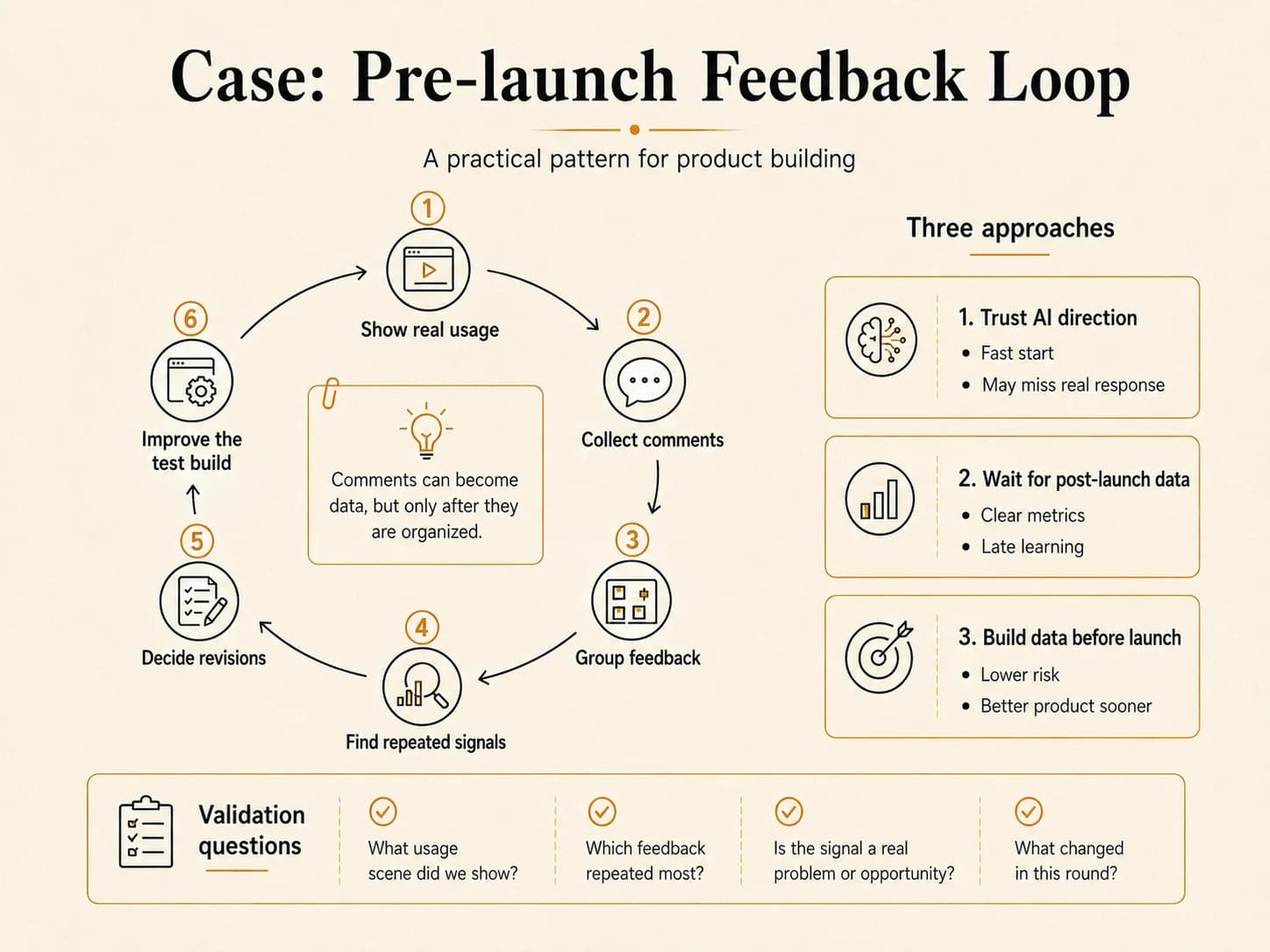
This flow is different from waiting only for metrics after launch. It's a way of showing usage scenes before launch, organizing scattered replies into repeated signals, then reflecting them in the next version.
Verification Questions
- Am I only waiting for data after launch?
- Am I missing feedback that can be obtained before launch?
- Am I just letting SNS replies and reactions pass by?
- Am I gathering feedback and organizing it into repeated signals?
- Am I checking actual user reactions before checking the direction AI set?
Newsletter
What's the open rate. Which newsletter topics get opened more. Which content leads to clicks. When does subscription cancellation increase — after which type of newsletter.
Learning Routine
Taking many lectures is different from being able to explain. Long learning time doesn't mean high learning effectiveness. In what way of studying do you retain information longer. Which routine actually proceeded as planned.
Recording learning time is different from testing whether you can actually explain what you learned. Data analysis should be used in the direction of confirming "what did you actually understand" rather than "how much did you study."
Monetization Experiments
When you followed the monetization direction AI recommended, did revenue actually happen. Which path did the conversion occur. Which content brought readers who convert to revenue.
Monetization is a process that takes time. Looking only at short-term data and drawing conclusions creates large errors. But if you don't look at data long-term, you can't know which direction is actually effective.
Key Verification Questions by Area Summary
| Area | Easy-to-fall-for Illusions | What to Verify with Data |
|---|---|---|
| Blog | I wrote a lot, so readership must have grown | Return rate, time spent |
| Social Media | Followers grew, so trust built up | Saves, comment quality, clicks |
| AI Automation | I adopted automation, so time must have decreased | Actual work time change |
| Newsletter | Many subscribers, so it reads well | Open rate, click rate, unsubscribe rate |
| Learning | I took many lectures, so I learned | Explainability, application results |
| Monetization | AI recommended it, so it must be effective | Actual conversion, revenue path |
There's something that applies commonly across all these areas.
The more choices you have, the more illusions you get.
The illusion that your preferred direction is actually effective. The illusion that doing more is the same as doing well. The illusion that a method that worked once will keep working.
Individuals need data not to become impressive analysts. They need it to reduce their own illusions.
Where Do Illusions Come From
Illusions usually come from three sources.
The first is selective memory. You remember successes big and failures small. If you wrote 10 articles last month and 2 went well, your memory builds around those 2. What happened with the other 8 becomes hazy.
The second is confirmation bias. Only signals supporting the direction you want to believe catch your eye. If you believe the direction AI recommended is correct, you pay more attention to signals showing that direction was effective and pay less attention to signals showing it wasn't.
The third is confusing effort with results. Trying hard is not the same as being effective. Writing many articles is not the same as actually connecting with readers.
Data provides balance against these three illusions. It makes you judge by record rather than memory, by trace rather than impression.
Data is cold, but that's what helps. Because it prevents you from being easily swayed by stories you want to believe.
Verification Questions
- Of the choices I've made recently, how many did I actually verify the results of?
- How am I distinguishing between what feels like it went well and what actually went well?
9. Why Data Analysis Became More Important in the AI Era
AI generates answers quickly.
It recommends content ideas. It extracts keywords. It creates titles. It explains automation methods. It organizes planning proposals. It suggests monetization directions. It outlines content strategy. It even logically arranges which direction would be better.
This speed is certainly useful. It lets you quickly start things that you would have had to spend a long time thinking about alone. The speed of decision-making has increased.
But a new problem emerges here.
The faster answers come, the sooner conviction arrives before verification.
When AI presents direction in well-organized sentences, it feels like it must be right. When the structure is clean and the logic is consistent, trust is built. But answers that look good are different from answers that are actually correct.
AI is good at speaking plausibly. But that plausibility does not guarantee real-world results.
The gap between AI's plausibility and actual results
AI said, "This topic matches current trends and has high search volume." You wrote that article. How long did readers actually stay on that article? Did they come back? Did they develop trust? AI cannot guarantee this.
AI said, "This automation method is efficient." You actually implemented it. Did it reduce time? Did it reduce errors? Did management burdens not arise? AI cannot verify this for you either.
Whether the direction AI proposed was correct cannot be determined solely by asking AI again. If you ask AI again, another plausible answer comes. But whether that answer aligns with the actual results remaining in reality can only be confirmed through data.
Prompt skill and result verification are different tasks
Using AI well and verifying the direction AI proposes are different abilities.
Writing better prompts lets you get better answers. But confirming how that good answer actually works in reality is the ability to read data.
In the AI era, both are necessary: using AI well and verifying how the answers AI created actually performed in reality.
AI automation and data verification
The more AI automation you introduce, the more important it becomes to verify the results of that automation.
Automation is fast. So it can go in the wrong direction quickly. When done manually, you notice mistakes quickly, but when automation goes wrong, many things may already be incorrectly processed before you even notice.
If you've implemented automation, you need to periodically check the results. Is the automation working as intended? Have no edge cases arisen? Is the method you originally designed still valid now? The specific routine for this is covered later in this article.
As AI makes choices faster, misconceptions also accumulate faster
Before the AI era, choices took time. You deliberated, researched, talked with people, and only then decided on a direction. Verification naturally happened in that process.
In the AI era, that process has been shortened. You quickly decide on a direction and execute it. This speed itself is useful, but if the confirmation process is omitted, misconceptions pile up.
If you don't ask whether the direction you thought was right actually was right, only execution becomes faster while direction goes unverified.
AI tells you about possibilities quickly. Data shows how those possibilities actually worked out in reality.
That's why the faster AI generates answers, the more important it becomes to verify those answers against reality.
AI analysis also requires verification
We've entered an era where AI analyzes data for us. Feed GA4 data and it summarizes insights. Upload a spreadsheet and it finds patterns. Show A/B test results and it tells you which is better.
This is also useful. But you need to be careful.
When AI does analysis for you, a person needs to verify whether the premises of that analysis are correct. What data did you input? How was that data collected? Does the context AI interpreted match the actual situation?
AI excels at finding patterns, but understanding the context of why those patterns emerged is something people who know the field do better. Before believing AI analysis as is, you should first judge whether that analysis fits your situation.
Why data literacy becomes more important in the AI era
Data literacy is the ability to read, understand, and critically interpret data.
The fact that AI helps with analysis doesn't make data literacy less necessary. It makes it more necessary.
To evaluate analysis results created by AI, you need to understand how data works. Determining which metrics are meaningful, which interpretations are valid, and what assumptions underlie AI's conclusions is a human task.
It's true that people who use AI better get better analysis. But verifying those analysis results against reality is still something people who understand data do better.
Verification Questions
- After executing the direction AI recommended, did you verify the actual results?
- What differences were there between AI's plausible explanation and the actual results?
- If you implemented AI automation, are you regularly checking the results?
10. What Data Shows and What It Cannot Show
To understand data analysis in a balanced way, you need to know both the possibilities and limitations of data.
What Data Shows
Traces of behavior. Who clicked where, where they left, how long they stayed.
Repeating patterns. A specific topic being searched repeatedly, repeated drop-offs from a specific page.
Direction of change. Whether time spent is increasing, whether bounce rate is rising.
Difference between expectation and reality. The gap between what I thought would be good and what actually got a response.
Drop-off points. At which stage people leave.
Change over time. The difference between last month and this month, between when I first tried it and now.
What Data Cannot Show
All of a person's intentions. We know which button was clicked but cannot know why it was clicked based on data alone. We know someone left but data often cannot explain why.
The full picture of long-term trust. We can know if return visit rate is high, but numbers do not completely capture whether readers actually trust this record.
The depth of emotion. We know a comment was made but need to read the text to know what emotion went into it.
The quality of meaning. Just because there are 1,000 views does not mean that post actually helped someone.
Areas not yet measured. Data is a trace of what was measured. What was not measured leaves no trace in the data.
Value not yet sufficiently accumulated. Even if there is no immediate response now, it may become an important record later. Data only shows what has happened so far.
Data is a Signal, Not Everything
It is important to understand both of these at the same time.
If you ignore data, misconceptions pile up. If you only trust data, you miss things that are not measured.
Data should be read together with questions. Is this number a signal to my question. What does this number fail to show. What other information do I need to see beyond this number.
The absence of data does not mean there is no value. The fact that measurement is difficult does not mean something is unimportant. The presence of data does not automatically produce truth either.
When Data Appears with Delay
The result of today's choice may not appear in today's data. Building good records consistently creates search traffic after six months. Content that builds trust does not show up in numbers right away.
If you look at data too short-term, you may give up choices that create long-term value. Just because something does not show up in data now does not mean it is meaningless.
Comparison of What Data Shows and What It Cannot Show
| What Data Shows | What Data Cannot Show |
|---|---|
| Views, time spent | Whether readers actually understood |
| Return visit rate | Why they came back |
| Drop-off point | What emotion they left with |
| Clicked links | Intent behind the click |
| Number of comments | The sincerity of comments |
| Conversion rate | Satisfaction after conversion |
| Number of followers | Actual level of trust |
| Time spent on work | Quality of work |
11. Quantitative Data and Qualitative Data
This is the most important distinction in dividing data.
Quantitative Data
Data measured in numbers. How much, how many times, to what extent.
Views: 1,203. Click-through rate: 4.2%. Time on page: 4 minutes 20 seconds. Bounce rate: 65%. Return visitor rate: 18%.
Quantitative data is easy to compare. How much it increased or decreased compared to last month. Which of two methods produced better numbers.
However, quantitative data is meaningless without context. Whether a 65% bounce rate is high or low depends on what type of page it is. A 65% bounce rate may be normal on a single page, but could be problematic in a multi-step flow.
Qualitative Data
Data that cannot be completely compressed into numbers.
Comment content. User feedback. Opinions heard directly. Patterns in repeated inquiries. Personal notes left by individuals. Conversation records.
Qualitative data accumulates slowly and is difficult to analyze. However, it often contains what numbers cannot capture.
A single comment saying "This article helped me organize a confusing concept" can tell you more than 10,000 views.
Qualitative data is especially important for individuals
Corporations have the scale to accumulate sufficient quantitative data. With tens of thousands of users, statistically meaningful numbers can be obtained quickly.
Individuals have smaller scale. If you have only hundreds of visitors, it's difficult to draw meaningful conclusions from quantitative data alone. One comment, one piece of feedback, one repeated question can tell you more than quantitative data.
"Why I couldn't understand this part"—a story from one reader who left this as a comment can be more helpful in changing the structure of your next article than time-on-page metrics.
Qualitative data doesn't only emerge after launch. As in the Dorong case discussed earlier, even without a finished product, replies and reactions that come back when you show the process of making can all become qualitative data. Quantitative data builds more clearly after launch, but qualitative data can be collected before launch. In early-stage products or personal projects, this qualitative data often changes direction faster.
How to collect qualitative data
Qualitative data often needs to be collected manually. These are things that don't get automatically aggregated.
Regularly read comments and feedback, and take notes on repeating patterns. "This kind of comment came up multiple times"—that's qualitative data. Asking direct questions is also a method. When you ask readers "Which part of this article was most helpful?" you get information that quantitative data won't capture.
Recording your own experience also becomes qualitative data. If you note down how you felt when following an AI's recommendation, what parts felt awkward, you can see patterns later.
Conflict between quantitative and qualitative data
Sometimes the two types of data point in different directions.
Quantitative data: This article had the highest views this month. Qualitative data: Multiple comments said "The content is too short for the title."
If you only look at views, you conclude it was a good article. But looking at qualitative data, there's a signal that the article didn't meet reader expectations.
Which one is right? Both are. High views signal strong discoverability, and comments signal insufficient content depth. Looking at both together gives you this judgment: "It was discoverable, but lacked depth. The content needs to be as substantial as the title promises."
Quantitative data shows patterns, qualitative data reveals reasons.
A sudden drop in time on page is something you can learn from quantitative data. Why it dropped requires looking together at whether the article's content changed, what reactions readers left, and what changes occurred.
Looking only at quantitative data tells you what happened, but not why. Looking only at qualitative data helps you understand why, but makes it difficult to grasp how serious the problem is.
Looking at both together is analysis.
Verification Questions
- Am I making judgments based only on quantitative data?
- Am I also recording qualitative data as a record?
12. Pitfalls in Data Analysis
I do not celebrate data analysis uncritically.
Having data does not automatically produce the right answer. Data analysis comes with pitfalls that become more treacherous the more familiar you become with it. In fact, the more numbers you observe, the easier it becomes to fall into these traps.
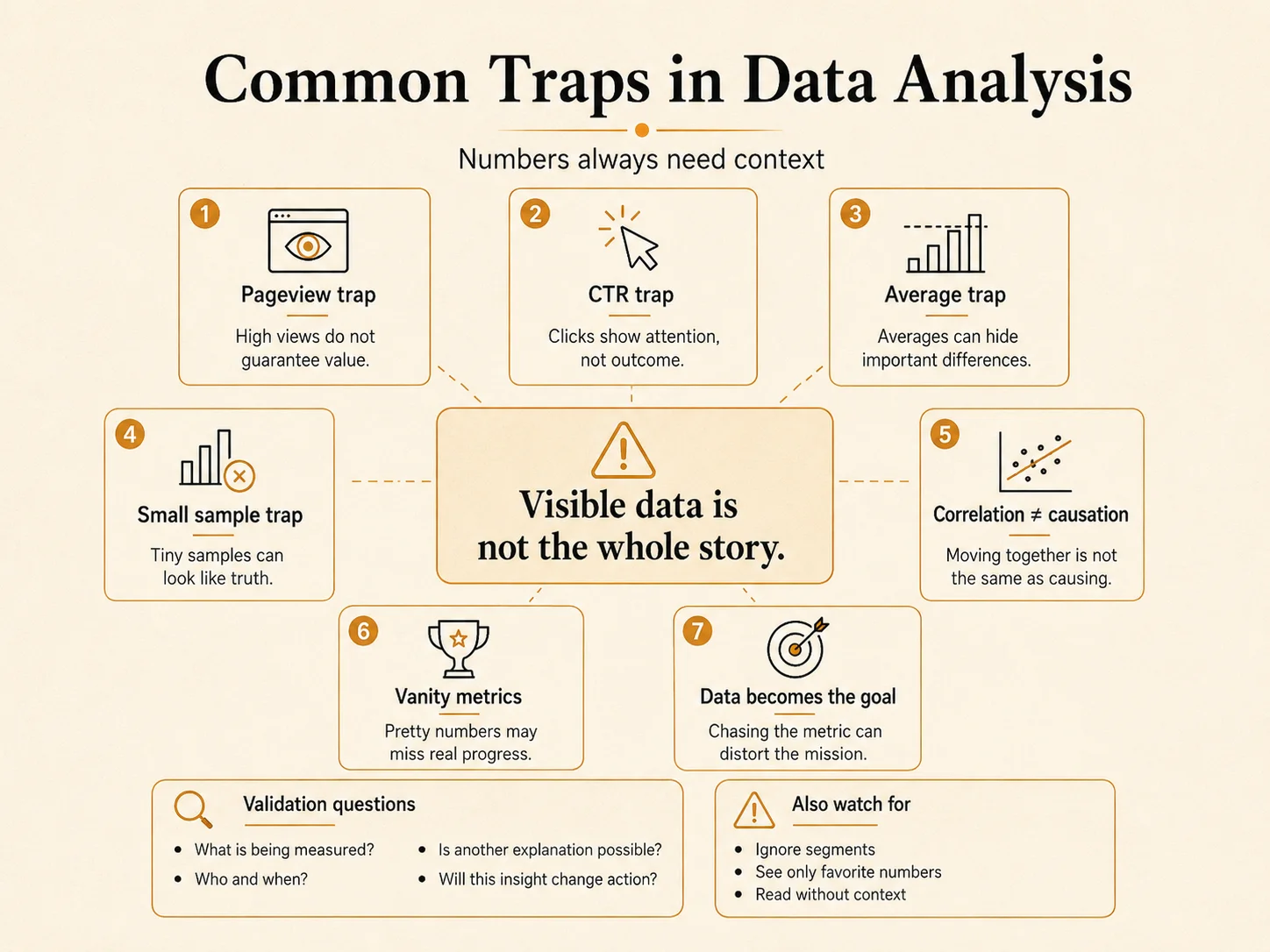
Looking at data does not automatically make you more accurate. Rather, once you start seeing numbers, you may rely on them and become mistaken even faster. That is why pitfalls come hand in hand with data analysis.
12.1 The Trap of View Counts
There is a misconception that high view counts mean good content.
View counts are a signal that something was discovered. They mean a click happened. But they do not mean the content was read. They do not mean trust was built. They do not mean the reader will return.
Even with high view counts, if average time on page is under 10 seconds, people may have been drawn in by the headline and left immediately after seeing the content. In this case, the view count is high but the actual reader experience is low.
Corporate example: If an ad has high click-through rates but low purchase conversion rates, the ad caught people's attention but failed to provide value that leads to actual purchases.
Personal example: A post with high view counts is not necessarily one that leaves readers with trust. A sensational headline may have driven the clicks.
How to avoid it: Do not view counts as your sole metric. Look at view counts alongside time on page, return visit rate, saves, and shares. High view counts combined with long time on page is a good signal. High view counts with short time on page may indicate a mismatch between headline and content.
Verification question: Are you looking at time on page, return visit rate, and save/share counts alongside view counts?
12.2 The Trap of Click-Through Rate
High click-through rates (CTR) appear to be good.
But one way to increase CTR is to write sensational headlines. Sensational headlines generate clicks, but if the content does not match expectations, they erode reader trust. CTR goes up but actual reader satisfaction goes down.
Short-term metrics and long-term trust can point in different directions. If you build headline strategy based only on CTR, you may see short-term gains but lose readers in the long run.
Corporate example: To increase email open rates, you write exaggerated subject lines. Short-term open rates rise, but unsubscribe rates may increase.
Personal example: You changed your headline to be more sensational and got more clicks. Did those readers come back?
How to avoid it: Look at behavior after the click alongside CTR. When CTR goes up, does time on page go up or down? If CTR increases but time on page decreases, the gap between headline and content has widened.
Verification question: When click-through rates improved, did subsequent reader behavior (time on page, return visits, shares) also improve?
12.3 The Trap of Averages
Averages smooth out the whole picture but can hide important differences.
Even if average time on page is 3 minutes, some posts may be read for 10 minutes while others are abandoned in 30 seconds. When you only look at averages, that difference disappears. You cannot tell from the average which posts are actually being read and which are being ignored.
Corporate example: Even if average customer purchase value increased, if a few customers made large purchases that drove up the average, the overall customer experience may not have improved.
Personal example: Average view counts for the month increased, but if one post went viral and skewed the overall average upward, your general post performance did not necessarily improve.
How to avoid it: When looking at averages, always view maximum and minimum values alongside them. If you cannot visualize the distribution, at minimum separate and examine the top 20% and bottom 20%.
Verification question: What distribution is hidden behind the average? Are you looking at highs and lows together?
12.4 The Trap of Small Samples
With too little data, you may mistake coincidence for pattern.
You wrote three posts and one performed well. It is too early to conclude "this direction is right." You cannot know whether the good performance came from the content itself, the timing of publication, traffic from a particular channel, or simply good luck.
Patterns should be identified only after sufficient observation accumulates. What counts as "enough" depends on the situation, but a pattern can only be claimed when you see repetition under the same conditions.
Corporate example: A/B test results from 100 subjects have lower statistical confidence than results from 10,000 subjects. Drawing conclusions too quickly from small samples can lead you in the wrong direction.
Personal example: You tried a new headline style and the first post had high clicks. It is too early to conclude that the headline style is effective.
How to avoid it: After trying a new approach, wait at least 2-4 weeks before drawing conclusions. Treat something as a pattern only when you see repetition under the same conditions. Distinguish between "this worked once" and "this direction continues to be effective."
Verification question: Do you have enough data accumulated to justify your conclusion? Are you seeing repetition?
12.5 Confusion Between Correlation and Causation
Just because two numbers move together does not mean one causes the other.
This is one of the most frequent errors in data analysis.
Example: Ice cream sales and swimming pool drowning deaths both increase together. Does ice cream cause drowning? No. Both increase because of a common factor: summer.
Corporate example: Earnings rose after launching a new feature. Did the feature cause it? If you also ran a marketing campaign at the same time and there were seasonal effects, you need to separate which factor caused the change.
Personal example: You changed your headline and view counts went up. Was it the headline? Someone may have shared the post that day, or search trends may have shifted.
To verify causation, you need to control variables. A/B testing, where you change only one thing and keep everything else the same, is helpful.
How to avoid it: When results change, make a list of what else changed at the same time. If you changed more than one thing, do not assume which is the cause. If possible, change one thing at a time and compare results.
Verification question: Are you concluding there is a causal relationship just because two numbers move together? Have you considered other factors?
12.6 The Problem of Only Measuring What is Measurable
When you only look at what is easy to measure, you end up ignoring what is hard to measure.
View counts, click-through rates, and conversion rates are easy to measure. Trust, depth, long-term impact, and community building are hard to measure. But that does not mean hard-to-measure things are less important.
Corporate example: If you measure customer satisfaction only through star ratings, you may miss customers who feel dissatisfied but do not leave a rating. The people who rate are different from those who silently leave.
Personal example: On Dechive, there may be posts with low view counts that people return to find years later. Their long-term value is not captured by short-term view counts.
How to avoid it: Regularly record qualitative notes on hard-to-measure values. Periodically ask yourself: "What was the most meaningful feedback this month?" and "Do I think this record will have value later?"
Verification question: Among the values you care about, which cannot be captured in numbers? How are you checking on those in other ways?
12.7 The Problem of Data Becoming the Goal
When improving metrics becomes the purpose, you can lose sight of the original goal.
Posts written long without substance to increase time on page. Focus on sensational headlines over content to boost view counts. Content created to chase reactions rather than build trust to grow followers.
These things improve metrics but weaken the original purpose.
Building good reader experience that naturally increases time on page is different from designing specifically to increase time on page. The former is purpose-driven; the latter is metric-driven.
Corporate example: When a customer service team's goal becomes "reduce customer inquiry resolution time," they may close tickets quickly without actually solving the problem. The metric improves but customer satisfaction drops.
Personal example: To increase time on page metrics, you started writing unnecessarily long introductions. The metric improved but readers got a worse experience.
How to avoid it: Before working to improve a metric, first ask: "If this metric goes up, does the original goal actually get achieved?" If the connection between metric and goal is weak, reconsider the metric or redefine the goal.
Verification question: Does the metric you are trying to improve actually reflect your original goal?
12.8 The Problem of Dashboard Replacing Reality
The more often you look at data, the easier it becomes to feel that the dashboard is all of reality.
A dashboard is a numerical summary of reality. But reality is richer than numbers. There are conversations, atmosphere, context, and subtle reactions that do not appear in numbers.
If you mistake looking at a dashboard for understanding the situation, you miss important things.
Corporate example: All metrics look good, but team fatigue is rising. The dashboard may not show problems accumulating underneath.
Personal example: Blog metrics are stable, but your motivation to write is declining. This significant change is invisible in the numbers.
12.9 The Problem of Only Seeing Numbers You Want to See
People tend to notice data more when it confirms what they already believe.
If you want to find evidence that a post performed well, you notice metrics that show it performed well. Conversely, if you do not want to accept that a direction is wrong, you downplay data suggesting it is.
This is called confirmation bias. Doing data analysis does not eliminate this bias. It may even lead you to find numbers that support your desired conclusion in a more sophisticated way.
One way to reduce it is to write down your hypothesis first, then look for data that proves your hypothesis wrong.
How to avoid it: Before starting analysis, first write down: "If this direction is wrong, what data would I see?" Check that data first before looking for positive signals. Looking for signals of being wrong first slightly reduces confirmation bias.
Verification question: Are you only checking numbers you want to see? Are you looking at contradictory signals equally?
12.10 The Problem of Ignoring Data-Free Areas
You end up thinking only the areas with data matter.
What you do not measure does not appear in data. But that does not mean unmeasured things are unimportant.
Building long-term trust, offline influence, learning effects not directly measured, relationships not yet visible. These do not get captured well by data. But ignoring them leads to short-term decision-making that only responds to current numbers.
How to avoid it: Regularly record qualitative observations in areas without data. Periodically write down: "What conversation today was meaningful?" and "What feedback from this month will I remember longest?" These records later become context for deciding direction.
12.11 The Problem of Being Deceived by Vanity Metrics
Vanity metrics are metrics that look good but do not actually help you make decisions.
Metrics like view counts, follower numbers, and cumulative visitors are not always problematic. But if these numbers do not connect to changing your next action, they become vanity metrics.
Corporate example: App downloads exceeded 1 million. The team celebrated. But checking 30-day retention revealed only 3%. Downloads were high but very few people actually kept using the app. Download counts looked good but were not connected to the actual goal (sustained use), making them vanity metrics.
Personal example: High view counts with low time on page and no return visits may not help you decide direction. Growing followers with no clicks, saves, comments, or return visits makes it hard to say trust is being built.
For a metric to be meaningful, it must be able to change your next action.
How to avoid it: Before looking at a metric, ask yourself first: "If this number changes, what would I do differently?" If you cannot answer that question, the metric may not be necessary for your current analysis.
Verification question: Among the metrics you track, which ones do not actually influence what you do next?
Verification Questions
- Is the metric you are looking at the one that best reflects your actual goal?
- Are you assuming your direction is right just because the numbers look good?
- Are you making an effort to understand what is happening in areas where you have no data?
- Of the numbers you track, how many actually change what you do next?
13. Data Is Also Subject to Verification
I've organized the pitfalls of data analysis. But before those pitfalls, there's something that must be addressed first.
Data itself is a subject of verification.
Just because numbers exist doesn't mean you can immediately trust those numbers.
What collection criteria were used?
Data produces different numbers depending on collection criteria. If the method of counting views differs, the same article will show different numbers. The meaning changes depending on whether visitors are counted by session or by user.
When looking at data, you must first understand what method was used to collect the numbers.
What was counted and what was not?
Views were counted. But was bot traffic excluded? Were visits from myself excluded? Could only visits from certain devices have been captured?
If something is missing from the collection process, the numbers show only part of reality.
Did the criteria change?
When tracking metrics, if the collection or calculation method changes, comparison becomes difficult. You compared last month's figures with this month's figures, but if the measurement criteria changed in between, the comparison itself is meaningless.
Is there bias?
Data might have been collected only from certain users or certain situations. Satisfied people leave feedback, while dissatisfied people simply leave. In this case, feedback data is skewed positively.
Did the measurement method change behavior?
When people know they are being measured, their behavior can change. When you start measuring employee productivity, there's a tendency to work only in ways that are measured. This is called "Goodhart's Law." When measurement becomes the goal, that measurement stops being a good metric.
Data interpretation involves people
You can reach different conclusions looking at the same numbers. Looking at a 60% bounce rate, you could say "readers found what they wanted and left," or "the content didn't meet expectations." The data itself doesn't tell you which interpretation is correct. You must look at context and other data together.
Real-world example: A moment when data needed verification
When I first connected GA4, the visitor count appeared much lower than actual. When I checked the reason, some visitors weren't being counted because of cookie rejection settings. There was data, but it only showed part of reality.
Blog dwell time doubled from the usual level. It looked like a good signal, but when I checked, images weren't loading on a specific page, so readers were waiting and leaving. The reason dwell time increased wasn't because of good content but because of a technical error.
In both cases, the numbers themselves weren't wrong. The context that generated the numbers was different. This is why, when looking at data, you must always view what conditions created those numbers.
This is why Dechive looks at data analysis from this perspective.
AI generates answers quickly. But you must verify with data how those answers actually work in reality. And that data itself cannot be trusted unconditionally. Data must also be verified.
Data doesn't replace judgment. Data makes you see your judgment again. And you must be able to reconsider how you read that data.
Verification Questions
- What method was used to collect this data?
- What might have been left out during the collection process?
- When interpreting this number, am I reading it in the direction I want to see?
14. How can individuals start data analysis
For individuals beginning data analysis, the most important thing is not having perfect tools. It is starting with a small routine.
14.1 Write down your question first
Write down what you want to check.
Good examples:
- Which of my articles get read for longer?
- What topics cause readers to return?
- Does the automation I introduced actually save time?
- What actual results came from following AI's recommendations?
Bad examples:
- I should analyze data.
- I should check metrics.
The more specific your question, the clearer it becomes what data you need to look at. "I should look at data" cannot be a starting point.
14.2 Write down your hypothesis
After your question, write down what result you expect.
Examples:
- Articles on topics recommended by AI will connect with readers.
- Specific task time will decrease after implementing automation.
- Click-through rate will increase if I shorten headlines.
When you have a hypothesis, you have a standard to compare against after seeing results. Learning happens when results differ from your hypothesis.
14.3 Choose only one metric to check
Do not try to look at everything at first. Choose one or two metrics closest to your question.
Examples:
- If you want to check "do articles get read longer" → time spent on page
- If you want to check "do they come back" → return visit rate
- If you want to check "does automation save time" → change in task time
The more metrics you have, the more confusing it becomes. At first, it's better to properly track one metric.
14.4 Record numbers and context together
Do not record just numbers. Also write down what happened that day.
Example:
| Date | Metric | Number | Context that day |
|---|---|---|---|
| Week 1 | Time on page | 4m 2s | Published AI-recommended topic |
| Week 2 | Time on page | 6m 45s | Published self-selected topic |
| Week 3 | Time on page | 3m 10s | Published with sensational headline |
| Week 4 | Time on page | 5m 28s | Returned to original headline style |
Recording this way lets you see numbers and context together.
In this recording method, baseline becomes important.
A baseline is a reference line for reading change. "Got better" and "got worse" only make sense when there is a reference line. If a specific task took an average of 40 minutes before automation, that 40 minutes is your baseline. If it becomes 25 minutes after, you can specifically say you saved 15 minutes. Without a reference line, even if there is change, you cannot tell if it is improvement or coincidence.
When you start recording, it is good to explicitly note "this current state is the baseline." Later, this baseline becomes the starting point for comparison.
Change is only readable when there is a baseline.
14.5 Set a time period
Do not just look at one day. Record by the same standard for at least 2-4 weeks or more.
A short period makes it easy to mistake coincidence for pattern. To distinguish whether one high number was just luck or actual improvement, you need to see repetition.
14.6 Do not reach conclusions too quickly
Do not reach conclusions immediately when data has accumulated a little. You can get closer to conclusion when you see repeating patterns.
In particular, if something worked once when you followed AI's recommendation, you cannot conclude that direction is always correct. When the same direction proves effective through multiple repetitions, only then can you call it a pattern.
14.7 Change your next action
When you have accumulated records, change your next choice.
If a certain topic was read longer, explore that direction further. If the direction AI recommended differed from actual results, next time check in a different way. If automation did not save time, change the structure.
Analysis has no meaning if it ends with recording. Your next action must change.
14.8 Record again
When you execute the next action, new data is generated. Record again. Compare again. Change again.
When this cycle repeats, your choices become gradually more accurate.
Blog 4-week recording routine example
| Metric | Check frequency | Comparison basis | Note |
|---|---|---|---|
| Time on page per article | Once per week | Previous week | Note topic, length |
| Traffic source per article | Once per week | Previous month | Where it came from |
| Return visit rate | Once per month | Previous month | New vs returning reader |
| Saves and shares | 2 weeks after | — | Pattern of responsive |
AI automation effect recording routine example
| Item | Before automation | After automation | Change |
|---|---|---|---|
| Specific task time | 45 min | 20 min | -25 min |
| Error occurrence | 2x per week | 1x per week | -1x |
| Management check time | None | 15 min | +15 min |
| Actual time saved | — | — | -25 +15 = -10min |
If automation saved 25 minutes but required 15 new minutes for management, the actual savings is 10 minutes. Without recording this, automation might feel like it saved much more time.
Adding monthly review routine
There are things that cannot be seen with just weekly routines. Through monthly review, you can check longer patterns.
What to check in monthly review:
- What are the common points of the 3 longest-read articles this month
- Between the direction recommended by AI and the direction I chose directly, which was more effective
- What performed well numerically this month but did not feel meaningful in reality
- What was meaningful but was not captured in numbers
- If you change just one thing next month, what would you change
Monthly review is not simple aggregation. It is reading this month's flow and setting new questions for next month.
Easy to misunderstand point There is a belief that good tools are needed first to start data analysis. But tools can be added later when needed. At first, one notepad and one question are enough. The purpose of analysis tools is to help answer questions faster, not to create questions for you.
15. Tools Commonly Used for Personal Data Analysis
Tool introduction is not the purpose of this article. However, having a rough understanding of what tools are available makes it easier to choose when needed. This section organizes not how to use tools, but rather in what situations which tools are used.
Google Analytics 4 (GA4)
Most commonly used for analyzing website or blog traffic. You can see page views, time on site, traffic sources, and return visitor rates. It's free and has a low setup difficulty.
If you run a blog or content site as an individual, GA4 is a good default setup. It's also possible to receive weekly or monthly reports via email.
Search Console
You can see what keywords your articles appear for in Google search and what your click-through rate is. It's used to understand which articles generate search traffic from an SEO perspective.
While GA4 shows behavior within your site, Search Console tells you how Google views your articles.
Notion / Spreadsheet
You don't need a dedicated tool. Manually recording date, metrics, and context in Notion or a spreadsheet is best when starting out. Building a habit of regular recording matters more than complex tools.
Substack / Newsletter Platform
If you run a newsletter, the platform provides open rates, click-through rates, and unsubscribe rates by default. You can see basic metrics without additional setup.
The commonality among these tools is that they collect data—they don't analyze it for you. You still need to decide what questions need answering.
Using AI as a Data Analysis Assistant Tool
You can copy GA4 data and paste it into AI, asking it to summarize insights. You can show AI your spreadsheet records and ask it to find patterns.
This is useful. But there are some caveats.
AI only finds patterns in the data you give it. It doesn't know what context produced those numbers or what exceptional circumstances existed. Even if AI says "this topic is effective," the traffic might have come because that topic was shared on a specific platform. You need to provide the context.
The best way to use AI as an analysis assistant is to include context along with data. If you add information like "this article was shared in a specific community in week 3 of May" or "publishing schedule changed in June," AI's analysis becomes more accurate.
Ultimately, you're using AI as an assistant tool, not as the agent of analysis. Deciding what questions need answering and how to connect those answers to your next decisions remains your responsibility.
16. Dechive-style Data Analysis Checklist
Core insights are organized into actionable verification criteria. Checking these questions first whenever you review data helps you avoid pitfalls.
Before starting your analysis
- What am I trying to verify? Is my question clear?
- If this question gets answered, how will my next action change?
- What result am I expecting? Did I write down my hypothesis first?
Before looking at the data
- How was this data collected?
- What might have been missed in the collection process?
- Has the measurement criteria changed recently?
- Is this data from a sufficient time period? Is the sample too small?
When interpreting the data
- Does this metric actually represent my question?
- What context exists behind this number?
- Am I only looking at the average? Am I also looking at the distribution?
- Am I mistaking correlation for causation?
- Am I only interpreting things in the direction I want to see?
Before drawing conclusions
- Have I looked at both quantitative and qualitative data?
- Have I thought about what might be happening in areas where I don't have data?
- Is improving the metric the same as achieving the original goal?
- Is this a situation that needs more observation, or can I already draw conclusions?
After changing your actions
- What differences were there between what the AI recommended and the actual results?
- Where was my judgment correct and where did it fall short?
- Are the lessons from this analysis leading to my next question?
Additional checks when AI is involved
- When I followed the AI's recommendation, did I actually verify the results?
- Do the assumptions in the AI's analysis match my situation?
- Did I verify how the data the AI analyzed was collected?
- Am I believing the AI without verification just because it sounds plausible?
The purpose of this checklist is not to achieve perfect analysis. It is to build a habit of questioning yourself when you look at data.
Honest questions come before perfect analysis. Asking yourself what you want to verify and whether that number actually shows it. That is where data analysis begins.
17. How Data Analysis Skills Are Built
The way you see data changes between when you first start analyzing it and when you become somewhat familiar with it.
Initial stage: Beginning to see numbers
You check page views, session duration, and return visit rate for the first time. You feel good when numbers go up, and anxious when they go down. You're still at a stage where you react excessively to a single number.
What matters at this stage is starting to keep records. It's okay if you don't completely understand the meaning of the numbers. You need data to accumulate before comparison becomes possible.
Intermediate stage: Reading with context
You start to see what happened behind the numbers. You try to distinguish whether this week's high page views are due to publishing a new post, traffic from a specific channel, or simply a seasonal effect.
You begin to form hypotheses and compare results. You look at the relationship between multiple metrics rather than a single indicator.
Mature stage: Questions become more sophisticated
Instead of asking "what are the page views," you ask "which readers come through which paths and stay on which articles?" While looking at metrics, you simultaneously question whether "this metric actually reflects our real goal."
You regularly ask about areas where you don't have data. The numbers are stable, but are you actually connecting with readers? Is unmeasured trust being built?
This maturity has nothing to do with using more tools. It's about questions becoming more sophisticated.
What each maturity stage actually looks like
Early stage in reality: "This week's page views are lower than usual and I'm worried. Something must be wrong."
Intermediate stage in reality: "This week's page views are down. It was a week when we didn't publish new posts, but the return visitor ratio is actually higher. Even without new posts, existing readers came back. A temporary drop in page views and maintained return visits are different signals."
Mature stage in reality: "This week without new posts had high return rates. Let me check which articles these returning readers came back to read. If I understand what characteristics those articles have, it can inform the direction of my next posts. At the same time, the fact that return visits are maintained even without new posts could signal that existing content has long-term value."
The exact same data prompts completely different questions. The more sophisticated the questions become, the more data reveals.
This maturity doesn't jump up suddenly. It rises gradually as you look at data, get it wrong, and look again repeatedly. The excessive reaction to page views you had at first naturally diminishes, and you begin to read deeper signals. That's the growth of data literacy.
Data literacy has no end point. The form of data created by AI keeps changing, and new measurement environments keep emerging. What matters is continuing to ask the most honest questions you can at your current level.
18. Is Data Analysis Only Needed for Businesses?
We return now to the original question.
Is data analysis only needed for businesses?
Corporate data analysis and personal data analysis are clearly different. The scale is different, the tools are different, and the scope of responsibility being handled is different.
Corporations track the behavior of thousands, tens of thousands of customers. Individuals observe the reactions of hundreds of readers. Corporations have dozens of team members participating in analysis. Individuals keep records alone.
Ignoring this difference leads in the direction of demanding corporate-level analysis from individuals. That is excessive.
But the essence is the same.
Corporations look at customers and revenue, while individuals look at the records they created and the results of their choices. Corporations verify whether advertising led to sales, while individuals verify whether the direction recommended by AI actually led to real results. Corporations verify whether products are actually being used, while individuals verify whether automation actually saved them time.
Verifying the results of choices. That is the essence of data analysis. This essence applies to both corporations and individuals.
In the age of AI, individuals also make choices more frequently and execute more quickly. The faster that speed becomes, the more important verification becomes.
19. Common Misconceptions About Data Analysis
"The more data you have, the better the analysis"
Not necessarily. Even with lots of data, without a clear question, you don't know where to look. Aimless exploration is just accumulating numbers, not analysis.
The clarity of your question comes before the quantity of data. One sharp question is better than ten vague metrics.
"Without data, you can't make a judgment"
There are times when you need to make decisions without data. When trying something new for the first time, when you need to set direction before enough data accumulates.
In those cases, the answer is to quickly generate data through small experiments. "We can't do it because we don't have data" easily becomes an excuse to avoid starting.
"Intuition and gut feeling are the opposite of data"
Intuition and gut feeling can be a starting point. Intuition born from long experience quickly points to what data you should look at.
Data doesn't replace intuition—it validates it. It's the process of checking how closely the direction you felt aligns with actual results.
"AI can do data analysis for us"
Partly true. AI can quickly help with pattern exploration, aggregation, visualization, and insight summarization.
But deciding what questions to ask, how to interpret them in context, and what judgments to make must be done by people. It's also up to humans to determine whether the results AI analyzed actually fit your situation.
AI can speed up the pace of analytical tools, but it cannot replace the purpose of analysis itself.
"Individuals need professional tools to do data analysis"
At the start, a simple notebook is enough. Recording what you wrote, what responses you got, what automation you introduced—along with dates. That's where data analysis begins.
Add tools once your records accumulate and you want to examine them more systematically.
20. Conclusion: Data Does Not Replace Judgment
Data is a trace left in reality. Not just numbers—actions, records, responses, and texts can all become data.
Reading those traces is data analysis. Both businesses and individuals operate within the same structure. Businesses confirm the results of their choices through advertisements, products, customers, and revenue. Individuals do the same confirmation through writing, automation, content, and learning outcomes. The scale and tools differ, but the structure of the question remains the same.
In the AI era, this confirmation has become more important. Choices have become faster. Whether the direction AI proposed was actually effective cannot be known even by asking AI again. You must look at the results that remain in reality.
You must also avoid the pitfalls of data analysis. View counts, click-through rates, averages, small samples, and confusing correlation with causation. Data alone does not automatically produce accurate judgment. Data itself is subject to verification.
Data analysis ability is not about tools—it's about maturing your questions. At first, you see numbers. Next, you see them with context. Later, you ask questions that also include areas where data does not exist.
Data analysis is not a technique needed only by businesses.
It is a way for people to reexamine the direction they believed in against the results of reality. Data is the material for that examination. It does not replace judgment, but it makes judgment more honest.
AI creates answers. Dechive verifies those answers. Data is one of the materials for that verification.
Verification is not about doubting AI. It is a process of making more accurate judgments together with AI. And when that process repeats, choices gradually move closer to reality.
The faster AI produces answers, the more important it becomes to confirm how those answers actually work in reality. The ability to make that confirmation possible is not a grand technique. It begins with an attitude of seeing the results of your choices as they truly are.